ERPNext: How a Complete Business Management Suite Automates Your Entire Growth
|
Ambibuzz Team
Introduction
Running a modern company is never simple. Every day, you're finding new customers, tracking goods, managing cash, and making sure your people get paid on time — and doing all of it by hand gets harder the moment your business starts actually growing.
Most companies don't fail at this because they lack effort. They fail because their data lives in ten different places at once — a WhatsApp thread here, a spreadsheet there, an invoicing app that doesn't talk to the inventory system. Every time someone copies a number from one app to another, there's a chance for a mistake to slip in. A single typing error can cost you a client. A missed reminder can mean forgetting to reorder stock until it's too late.
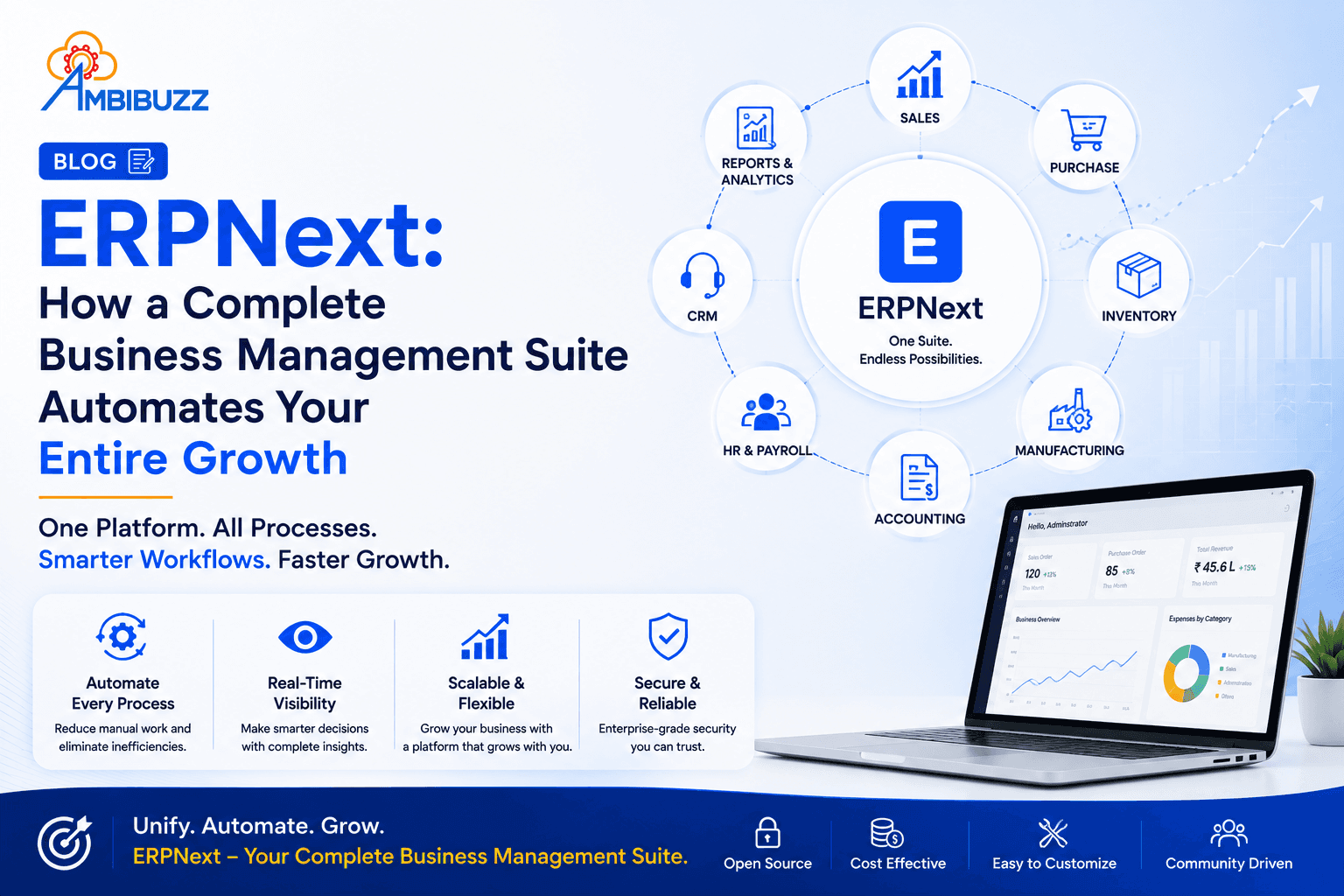
This is exactly why growing businesses need a complete business management suite — one system that brings sales, inventory, accounting, and HR onto a single screen, so nothing falls through the cracks between departments.
Picture what that actually looks like in practice: a sale comes in, and the same system that recorded it updates your inventory, alerts your warehouse, and posts the transaction to your books — automatically, in real time, without anyone re-typing a single number.
Let's walk through exactly how this works, and how Ambibuzz builds it for Indian businesses using ERPNext.
Table Of Content
Can I Track Supply Chain and Inventory in Real Time Across India?
Why Is Multi-Warehouse Tracking Important for Local Expansion?
How Does Accurate Landed Cost Valuation Protect Profit Margins?
What If My Business Deals with Global Clients and Currencies?
What Are the Best HR and Payroll Solutions for Growing Teams?
Why Is Analytics and Infrastructure Vital for Long-Term Success?
What Are the Benefits of Cloud Hosting and Open-Source Freedom?
What Is a Complete Business Management Suite?
A complete suite is all-in-one software built to run your entire business — think of it as a digital brain that replaces the maze of spreadsheets and disconnected apps most companies quietly struggle with.
It brings sales, stock, accounting, and HR into one place. When a sale happens, the whole system knows instantly: your inventory count drops, your expected revenue updates, and nobody has to type the same data twice into two different tools.
This kind of ERP software for India's SMEs is built to scale with you. Small businesses use it to operate with the discipline of much larger companies. Large companies use it to stay organized as they expand into new cities, categories, and teams. For growing Indian businesses, it's one of the smartest technology investments available today.
Ambibuzz specializes in bringing this to Indian companies using ERPNext, one of the world's most capable open-source ERP platforms — configured to fit your business exactly, not the other way around.
How Does a Unified System Help Indian Businesses Grow?
Indian businesses face a genuinely unique set of daily challenges. The market moves fast, competition is fierce, GST compliance is non-negotiable, and supply chains often stretch across huge distances between cities and states.
A unified system solves these local problems directly. It gives you a clear, single view of your entire operation — which regions are buying the most, which vendors consistently give you the best rates, and where your money is actually going. It also keeps you compliant with Indian tax law automatically, so a missed GST deadline never becomes a genuine business risk.
When daily operations run on automation instead of manual paperwork, your team spends less time on repetitive admin work and more time actually building relationships with buyers. That shift — from paperwork to relationships — is where real, compounding growth starts.
How Can Sales and CRM Boost My Revenue?
Finding new buyers is the most important job in any business, and a good ERPNext CRM gives you a genuinely unified lead-to-deal flow — tracking a buyer from their very first "hello" all the way through to a closed sale.
Every new lead lands in a secure digital database, with phone logs and emails linked directly to the record. If a salesperson ever leaves the company, the client relationship doesn't leave with them — the next person can read the full history and pick up right where things left off.
You also get clear, visual sales funnel reports that show exactly how your sales team is performing — how many leads actually convert, and precisely where prospects tend to drop off. That visibility lets you fix a weak sales pitch quickly, coach your team toward faster closes, and turn better tracking into measurably higher monthly revenue.
A quick thought before we go further: if any of this — lost leads, scattered client history, unclear conversion rates — sounds familiar, it's worth a conversation. Book a free demo with Ambibuzz and we'll walk through exactly how this would look for your sales team.
What Is the Best Way to Create Quotations and Sales Orders?
Building a price quote by hand takes far longer than it should. With a complete suite, quotation-to-sales-order automation means the system already knows your item prices and the correct applicable tax rates — you simply select the customer and the items, and a professional PDF quote is generated instantly.
You can email it directly from the software, and even track whether the customer has opened it. Once they say yes, converting that quote into a confirmed sales order takes one click — with zero manual re-typing.
This single click locks in the sale and immediately alerts your warehouse team on exactly what needs to be packed and shipped, making the entire process fast, smooth, and effectively error-free.
Can I Track Supply Chain and Inventory in Real Time Across India?
Managing physical stock is one of the trickiest parts of running any business — run out, and you lose sales; overstock, and your cash sits trapped on a shelf. A genuine full-cycle purchase-to-sales flow, backed by real-time inventory tracking software, solves both problems at once.
The system always knows exactly what's on your shelves right now, and what's currently in transit on a delivery truck. When stock runs low, it sends an alert — and can even generate the purchase order automatically, ready for you to review and send to your supplier with a single click.
When new goods arrive, logging the material receipt updates your total item counts instantly, and your sales team can see stock is available again immediately — no delay, no guessing.
Why Is Multi-Warehouse Tracking Important for Local Expansion?
As your business grows, more storage locations usually follow — a warehouse in Delhi, another in Mumbai, maybe a third somewhere else entirely. Tracking stock accurately across cities is genuinely difficult without the right multi-warehouse inventory management software.
A complete suite lets you manage as many locations as you need, with exact stock visibility at every single site. Moving items between warehouses is tracked automatically, and you can set different safety stock levels for each location — because what Delhi needs in winter stock is rarely what Mumbai needs.
Add barcode and QR scanning tools, and your warehouse team can pick and pack orders significantly faster, with far less risk of shipping the wrong item by mistake.
Why Do Manufacturers Need Simplified Cost Control Tools?
Manufacturing involves real complexity — sourcing raw materials, storing them safely, and combining them into a finished product without losing track of costs along the way. This is where BOM (Bill of Materials) and work order management ERP tools genuinely earn their keep.
You start by building a digital "recipe" for your product — the Bill of Materials — which tells the system exactly what raw materials are required. When production begins, a work order tells your factory floor precisely what to build. Once the job is complete, the system automatically removes consumed raw materials from stock and adds the newly finished goods to inventory.
This removes the headache of manual inventory updates entirely. You always know exactly what materials remain, and you never have to halt a production line because nobody noticed you'd run out.
How Does Accurate Landed Cost Valuation Protect Profit Margins?
Knowing your true cost is the only real way to protect your margins — yet many businesses only track the obvious costs, forgetting shipping fees, customs duties, and local taxes that quietly eat into profit.
Accurate landed cost valuation lets you add these extra charges directly to each item's cost, so the system calculates the true, final cost of every unit you hold. That means your real-time stock ledger reflects reality, not an incomplete estimate — giving you valuation reports you can actually trust.
With accurate landed costs, your pricing strategy is built on solid ground. You'll never unknowingly sell something for less than it actually cost you to bring to market.
How Can Financials and GST Compliance Be Automated Easily?
Accounting is often the most stressful part of running an Indian business — which is exactly why GST compliant ERP software matters so much. A complete suite comes pre-configured with IndAS-compliant charts of accounts, so you don't need to be a tax expert to use it correctly.
Multi-slab tax templates calculate the correct CGST, SGST, or IGST automatically on every invoice, removing the guesswork from daily billing. You can generate e-Invoices with a single click, with the software communicating directly with government tax portals — and generate the required e-Way Bills just as easily, keeping your goods moving legally without delay.
This alone can save your accounting team weeks of manual work every year.
Worth pausing here: if GST compliance and month-end reconciliation currently eat up more of your team's time than they should, this is usually the single fastest ROI area in an ERP rollout. Talk to Ambibuzz about what this would look like for your books specifically.
What If My Business Deals with Global Clients and Currencies?
More Indian businesses are selling internationally than ever, and juggling dollars, euros, and pounds against constantly shifting exchange rates can get genuinely confusing without the right tools.
Multi-currency support automatically fetches live exchange rates, recording the correct rupee value the moment you bill a client in a foreign currency. When payment finally arrives weeks later — often at a different rate — the system handles the difference automatically, posting any exchange gain or loss straight to your ledger without manual intervention.
If you manage a group of companies, consolidated group reporting gives you the total financial health of your entire portfolio in one unified view.
What Are the Best HR and Payroll Solutions for Growing Teams?
Your people are the engine behind everything else in this article — which is why a strong HRMS software India solution handles the full journey from recruitment to onboarding in one place.
Post job openings, track resumes, schedule interviews, and record feedback — all in one system. Once you've found the right person, send a digital offer letter, and when they accept, an onboarding checklist ensures they get their laptop, email access, and training on schedule, so their first day actually feels organized.
From there, the system tracks daily attendance and handles payroll automation with real precision — no more manual salary math, and no more late-night spreadsheet reconciliation before payday.
How Can Biometrics and Self-Service Apps Help My Staff?
Manual attendance tracking is slow and error-prone. A modern business suite connects directly to biometric scanners — a fingerprint scan logs the exact time, which then feeds directly into accurate salary calculations, including deductions for late days, absences, provident fund, and tax cuts.
Your staff also get an employee self-service mobile app, letting them check leave balances, request time off, submit expense claims by photographing a receipt, and securely download their own pay slips — all from their own phone. Giving employees this kind of visibility builds genuine trust, and it tends to show up in retention numbers over time.
Why Is Analytics and Infrastructure Vital for Long-Term Success?
You can't fix a problem you can't see, and you can't grow a trend you're not tracking. This is where a business intelligence dashboard earns its place as one of the most underrated parts of any ERP rollout.
A complete suite delivers module-level KPI dashboards — clear, visual charts covering total sales, cash flow, and your best-performing products. You can spot a bad month early enough to correct course, see exactly which salesperson is closing the most deals, and make decisions based on solid data instead of gut feel.
Because this data is genuinely valuable, it needs to be kept secure — which is why modern suites run on secure cloud deployment, with your information stored on hardened, enterprise-grade servers.
What Are the Benefits of Cloud Hosting and Open-Source Freedom?
Older ERP systems required businesses to buy and maintain physical servers on-site, along with the IT staff to keep them running. A modern suite instead runs on AWS, Azure, or GCP — meaning experts manage your infrastructure remotely, with bank-level SSL security and automatic daily backups built in.
This is also where open-source ERP genuinely sets ERPNext apart. There's no vendor lock-in, no being trapped by a provider who controls your pricing indefinitely. You retain full control over your own code and your own data, with the freedom to add custom features whenever your business needs them — without expensive recurring license fees stacking up year after year.
Why Do I Need an Expert Partner to Set This Up?
Buying powerful software is only step one. Setting it up correctly is where most ERP projects actually succeed or fail — because every business has its own quirks, exceptions, and unwritten rules that a generic setup will miss entirely.
A poorly implemented ERP creates more chaos than the spreadsheets it replaced. What you need is an expert who understands both the software and how your business genuinely operates day to day — someone who studies how your factory or office actually runs, maps the software to your real workflows, migrates your existing data cleanly, and trains your team with patience, because change is never easy for people in the middle of a busy operation.
Why Is Data Security So Important for Local Businesses?
When your operations run across many disconnected apps, your data is more exposed than most business owners realize — client lists can walk out the door on a USB stick, and spreadsheets get deleted by accident more often than anyone likes to admit.
A unified system acts as a secure digital fortress — a single source of truth that every employee works from. Strict role-based access controls mean a warehouse worker can see stock levels but never your bank balances, and a junior salesperson can view client records but can't delete critical files. That kind of structured security protects your company's most sensitive information, and it builds real trust with the clients who depend on you to protect theirs too.
Can Small and Medium Businesses Actually Afford Complete Suites?
Years ago, ERP software was priced for massive global brands — millions of rupees and multi-year build times. Cloud technology has permanently changed that equation.
Today, small and medium Indian businesses can genuinely afford a complete suite. Because it's cloud-based, you pay for what you actually use. Because it's open-source, you avoid the licensing costs that once made ERP a large-enterprise-only tool.
The real financial risk, in fact, runs the other way: businesses lose money quietly every month to spoiled inventory nobody tracked, and leads that were never followed up on. A good business management suite closes exactly these leaks — and for most growing companies, it pays for itself well within the first year through faster, more accurate operations.
How Does a Unified Suite Improve Customer Satisfaction?
At the end of the day, your customers are what actually determines whether your business grows. A unified suite helps you serve them meaningfully faster — when a client calls about an order, you can pull up their entire history instantly and tell them exactly where their shipment is, without placing them on hold while someone calls the warehouse to check.
Accurate billing, on-time delivery, and fast, confident answers all build the kind of trust that turns a one-time buyer into a repeat customer — which, over time, is the real engine behind sustainable business growth.
Frequently Asked Questions
What is the best ERP software for small businesses in India? For most Indian SMEs, ERPNext offers the strongest combination of capability, affordability, and flexibility — it's open-source, cloud-deployable, and natively built for GST and Indian compliance requirements, without the licensing costs of larger enterprise platforms.
How long does it take to implement a complete business management suite? Implementation timelines vary by business complexity, but a well-scoped rollout for a mid-sized company typically takes 6–12 weeks when process mapping and data migration are handled properly from the start.
Is cloud ERP secure for Indian businesses? Yes — cloud ERP hosted on platforms like AWS, Azure, or GCP includes bank-level SSL security and automated daily backups, generally making it far more secure than data spread across local spreadsheets and disconnected apps.
Can ERPNext handle GST and Indian tax compliance automatically? Yes. ERPNext comes with multi-slab GST tax templates, automatic CGST/SGST/IGST calculation, and native e-Invoice and e-Way Bill generation — built specifically for Indian regulatory requirements.
Do I need to implement every module at once? No — a modular ERP approach lets you start with the modules you need most (commonly sales or finance) and add inventory, manufacturing, or HR as your business is ready for them.
Why Choose Ambibuzz for Your Business Management Suite?
You now know exactly why a complete management suite matters — it connects your sales, stock, production, finance, and people into one working system. What you need next is a trusted partner to actually bring it to life.
This is exactly why Indian businesses choose to work with Ambibuzz. We're specialists in end-to-end digital transformation, with deep experience implementing ERPNext across manufacturing, trading, and service industries. We don't hand you software and disappear — we sit with you to understand your real business pain points, customize dashboards so they genuinely make sense to your team, and train your people until they're confident, not just compliant.
We stay a phone call away long after go-live, because our goal isn't a one-time project — it's being your long-term technology growth partner.
Ready to stop losing hours to manual paperwork and start scaling with real digital tools?
Visit Ambibuzz today to book your free demo — let's build a smarter, faster, more profitable business together.
What Is a Complete Business Management Suite?
A complete suite is all-in-one software built to run your entire business — think of it as a digital brain that replaces the maze of spreadsheets and disconnected apps most companies quietly struggle with.
It brings sales, stock, accounting, and HR into one place. When a sale happens, the whole system knows instantly: your inventory count drops, your expected revenue updates, and nobody has to type the same data twice into two different tools.
This kind of ERP software for India's SMEs is built to scale with you. Small businesses use it to operate with the discipline of much larger companies. Large companies use it to stay organized as they expand into new cities, categories, and teams. For growing Indian businesses, it's one of the smartest technology investments available today.
Ambibuzz specializes in bringing this to Indian companies using ERPNext, one of the world's most capable open-source ERP platforms — configured to fit your business exactly, not the other way around.
How Does a Unified System Help Indian Businesses Grow?
Indian businesses face a genuinely unique set of daily challenges. The market moves fast, competition is fierce, GST compliance is non-negotiable, and supply chains often stretch across huge distances between cities and states.
A unified system solves these local problems directly. It gives you a clear, single view of your entire operation — which regions are buying the most, which vendors consistently give you the best rates, and where your money is actually going. It also keeps you compliant with Indian tax law automatically, so a missed GST deadline never becomes a genuine business risk.
When daily operations run on automation instead of manual paperwork, your team spends less time on repetitive admin work and more time actually building relationships with buyers. That shift — from paperwork to relationships — is where real, compounding growth starts.
How Can Sales and CRM Boost My Revenue?
Finding new buyers is the most important job in any business, and a good ERPNext CRM gives you a genuinely unified lead-to-deal flow — tracking a buyer from their very first "hello" all the way through to a closed sale.
Every new lead lands in a secure digital database, with phone logs and emails linked directly to the record. If a salesperson ever leaves the company, the client relationship doesn't leave with them — the next person can read the full history and pick up right where things left off.
You also get clear, visual sales funnel reports that show exactly how your sales team is performing — how many leads actually convert, and precisely where prospects tend to drop off. That visibility lets you fix a weak sales pitch quickly, coach your team toward faster closes, and turn better tracking into measurably higher monthly revenue.
A quick thought before we go further: if any of this — lost leads, scattered client history, unclear conversion rates — sounds familiar, it's worth a conversation. Book a free demo with Ambibuzz and we'll walk through exactly how this would look for your sales team.
What Is the Best Way to Create Quotations and Sales Orders?
Building a price quote by hand takes far longer than it should. With a complete suite, quotation-to-sales-order automation means the system already knows your item prices and the correct applicable tax rates — you simply select the customer and the items, and a professional PDF quote is generated instantly.
You can email it directly from the software, and even track whether the customer has opened it. Once they say yes, converting that quote into a confirmed sales order takes one click — with zero manual re-typing.
This single click locks in the sale and immediately alerts your warehouse team on exactly what needs to be packed and shipped, making the entire process fast, smooth, and effectively error-free.
Can I Track Supply Chain and Inventory in Real Time Across India?
Managing physical stock is one of the trickiest parts of running any business — run out, and you lose sales; overstock, and your cash sits trapped on a shelf. A genuine full-cycle purchase-to-sales flow, backed by real-time inventory tracking software, solves both problems at once.
The system always knows exactly what's on your shelves right now, and what's currently in transit on a delivery truck. When stock runs low, it sends an alert — and can even generate the purchase order automatically, ready for you to review and send to your supplier with a single click.
When new goods arrive, logging the material receipt updates your total item counts instantly, and your sales team can see stock is available again immediately — no delay, no guessing.
Why Is Multi-Warehouse Tracking Important for Local Expansion?
As your business grows, more storage locations usually follow — a warehouse in Delhi, another in Mumbai, maybe a third somewhere else entirely. Tracking stock accurately across cities is genuinely difficult without the right multi-warehouse inventory management software.
A complete suite lets you manage as many locations as you need, with exact stock visibility at every single site. Moving items between warehouses is tracked automatically, and you can set different safety stock levels for each location — because what Delhi needs in winter stock is rarely what Mumbai needs.
Add barcode and QR scanning tools, and your warehouse team can pick and pack orders significantly faster, with far less risk of shipping the wrong item by mistake.
Why Do Manufacturers Need Simplified Cost Control Tools?
Manufacturing involves real complexity — sourcing raw materials, storing them safely, and combining them into a finished product without losing track of costs along the way. This is where BOM (Bill of Materials) and work order management ERP tools genuinely earn their keep.
You start by building a digital "recipe" for your product — the Bill of Materials — which tells the system exactly what raw materials are required. When production begins, a work order tells your factory floor precisely what to build. Once the job is complete, the system automatically removes consumed raw materials from stock and adds the newly finished goods to inventory.
This removes the headache of manual inventory updates entirely. You always know exactly what materials remain, and you never have to halt a production line because nobody noticed you'd run out.
How Does Accurate Landed Cost Valuation Protect Profit Margins?
Knowing your true cost is the only real way to protect your margins — yet many businesses only track the obvious costs, forgetting shipping fees, customs duties, and local taxes that quietly eat into profit.
Accurate landed cost valuation lets you add these extra charges directly to each item's cost, so the system calculates the true, final cost of every unit you hold. That means your real-time stock ledger reflects reality, not an incomplete estimate — giving you valuation reports you can actually trust.
With accurate landed costs, your pricing strategy is built on solid ground. You'll never unknowingly sell something for less than it actually cost you to bring to market.
How Can Financials and GST Compliance Be Automated Easily?
Accounting is often the most stressful part of running an Indian business — which is exactly why GST compliant ERP software matters so much. A complete suite comes pre-configured with IndAS-compliant charts of accounts, so you don't need to be a tax expert to use it correctly.
Multi-slab tax templates calculate the correct CGST, SGST, or IGST automatically on every invoice, removing the guesswork from daily billing. You can generate e-Invoices with a single click, with the software communicating directly with government tax portals — and generate the required e-Way Bills just as easily, keeping your goods moving legally without delay.
This alone can save your accounting team weeks of manual work every year.
Worth pausing here: if GST compliance and month-end reconciliation currently eat up more of your team's time than they should, this is usually the single fastest ROI area in an ERP rollout. Talk to Ambibuzz about what this would look like for your books specifically.
What If My Business Deals with Global Clients and Currencies?
More Indian businesses are selling internationally than ever, and juggling dollars, euros, and pounds against constantly shifting exchange rates can get genuinely confusing without the right tools.
Multi-currency support automatically fetches live exchange rates, recording the correct rupee value the moment you bill a client in a foreign currency. When payment finally arrives weeks later — often at a different rate — the system handles the difference automatically, posting any exchange gain or loss straight to your ledger without manual intervention.
If you manage a group of companies, consolidated group reporting gives you the total financial health of your entire portfolio in one unified view.
What Are the Best HR and Payroll Solutions for Growing Teams?
Your people are the engine behind everything else in this article — which is why a strong HRMS software India solution handles the full journey from recruitment to onboarding in one place.
Post job openings, track resumes, schedule interviews, and record feedback — all in one system. Once you've found the right person, send a digital offer letter, and when they accept, an onboarding checklist ensures they get their laptop, email access, and training on schedule, so their first day actually feels organized.
From there, the system tracks daily attendance and handles payroll automation with real precision — no more manual salary math, and no more late-night spreadsheet reconciliation before payday.
How Can Biometrics and Self-Service Apps Help My Staff?
Manual attendance tracking is slow and error-prone. A modern business suite connects directly to biometric scanners — a fingerprint scan logs the exact time, which then feeds directly into accurate salary calculations, including deductions for late days, absences, provident fund, and tax cuts.
Your staff also get an employee self-service mobile app, letting them check leave balances, request time off, submit expense claims by photographing a receipt, and securely download their own pay slips — all from their own phone. Giving employees this kind of visibility builds genuine trust, and it tends to show up in retention numbers over time.
Why Is Analytics and Infrastructure Vital for Long-Term Success?
You can't fix a problem you can't see, and you can't grow a trend you're not tracking. This is where a business intelligence dashboard earns its place as one of the most underrated parts of any ERP rollout.
A complete suite delivers module-level KPI dashboards — clear, visual charts covering total sales, cash flow, and your best-performing products. You can spot a bad month early enough to correct course, see exactly which salesperson is closing the most deals, and make decisions based on solid data instead of gut feel.
Because this data is genuinely valuable, it needs to be kept secure — which is why modern suites run on secure cloud deployment, with your information stored on hardened, enterprise-grade servers.
What Are the Benefits of Cloud Hosting and Open-Source Freedom?
Older ERP systems required businesses to buy and maintain physical servers on-site, along with the IT staff to keep them running. A modern suite instead runs on AWS, Azure, or GCP — meaning experts manage your infrastructure remotely, with bank-level SSL security and automatic daily backups built in.
This is also where open-source ERP genuinely sets ERPNext apart. There's no vendor lock-in, no being trapped by a provider who controls your pricing indefinitely. You retain full control over your own code and your own data, with the freedom to add custom features whenever your business needs them — without expensive recurring license fees stacking up year after year.
Why Do I Need an Expert Partner to Set This Up?
Buying powerful software is only step one. Setting it up correctly is where most ERP projects actually succeed or fail — because every business has its own quirks, exceptions, and unwritten rules that a generic setup will miss entirely.
A poorly implemented ERP creates more chaos than the spreadsheets it replaced. What you need is an expert who understands both the software and how your business genuinely operates day to day — someone who studies how your factory or office actually runs, maps the software to your real workflows, migrates your existing data cleanly, and trains your team with patience, because change is never easy for people in the middle of a busy operation.
Why Is Data Security So Important for Local Businesses?
When your operations run across many disconnected apps, your data is more exposed than most business owners realize — client lists can walk out the door on a USB stick, and spreadsheets get deleted by accident more often than anyone likes to admit.
A unified system acts as a secure digital fortress — a single source of truth that every employee works from. Strict role-based access controls mean a warehouse worker can see stock levels but never your bank balances, and a junior salesperson can view client records but can't delete critical files. That kind of structured security protects your company's most sensitive information, and it builds real trust with the clients who depend on you to protect theirs too.
Can Small and Medium Businesses Actually Afford Complete Suites?
Years ago, ERP software was priced for massive global brands — millions of rupees and multi-year build times. Cloud technology has permanently changed that equation.
Today, small and medium Indian businesses can genuinely afford a complete suite. Because it's cloud-based, you pay for what you actually use. Because it's open-source, you avoid the licensing costs that once made ERP a large-enterprise-only tool.
The real financial risk, in fact, runs the other way: businesses lose money quietly every month to spoiled inventory nobody tracked, and leads that were never followed up on. A good business management suite closes exactly these leaks — and for most growing companies, it pays for itself well within the first year through faster, more accurate operations.
How Does a Unified Suite Improve Customer Satisfaction?
At the end of the day, your customers are what actually determines whether your business grows. A unified suite helps you serve them meaningfully faster — when a client calls about an order, you can pull up their entire history instantly and tell them exactly where their shipment is, without placing them on hold while someone calls the warehouse to check.
Accurate billing, on-time delivery, and fast, confident answers all build the kind of trust that turns a one-time buyer into a repeat customer — which, over time, is the real engine behind sustainable business growth.
Frequently Asked Questions
What is the best ERP software for small businesses in India? For most Indian SMEs, ERPNext offers the strongest combination of capability, affordability, and flexibility — it's open-source, cloud-deployable, and natively built for GST and Indian compliance requirements, without the licensing costs of larger enterprise platforms.
How long does it take to implement a complete business management suite? Implementation timelines vary by business complexity, but a well-scoped rollout for a mid-sized company typically takes 6–12 weeks when process mapping and data migration are handled properly from the start.
Is cloud ERP secure for Indian businesses? Yes — cloud ERP hosted on platforms like AWS, Azure, or GCP includes bank-level SSL security and automated daily backups, generally making it far more secure than data spread across local spreadsheets and disconnected apps.
Can ERPNext handle GST and Indian tax compliance automatically? Yes. ERPNext comes with multi-slab GST tax templates, automatic CGST/SGST/IGST calculation, and native e-Invoice and e-Way Bill generation — built specifically for Indian regulatory requirements.
Do I need to implement every module at once? No — a modular ERP approach lets you start with the modules you need most (commonly sales or finance) and add inventory, manufacturing, or HR as your business is ready for them.
Why Choose Ambibuzz for Your Business Management Suite?
You now know exactly why a complete management suite matters — it connects your sales, stock, production, finance, and people into one working system. What you need next is a trusted partner to actually bring it to life.
This is exactly why Indian businesses choose to work with Ambibuzz. We're specialists in end-to-end digital transformation, with deep experience implementing ERPNext across manufacturing, trading, and service industries. We don't hand you software and disappear — we sit with you to understand your real business pain points, customize dashboards so they genuinely make sense to your team, and train your people until they're confident, not just compliant.
We stay a phone call away long after go-live, because our goal isn't a one-time project — it's being your long-term technology growth partner.
Ready to stop losing hours to manual paperwork and start scaling with real digital tools?
Visit Ambibuzz today to book your free demo — let's build a smarter, faster, more profitable business together.
Table Of Content
Can I Track Supply Chain and Inventory in Real Time Across India?
Why Is Multi-Warehouse Tracking Important for Local Expansion?
How Does Accurate Landed Cost Valuation Protect Profit Margins?
What If My Business Deals with Global Clients and Currencies?
What Are the Best HR and Payroll Solutions for Growing Teams?
Why Is Analytics and Infrastructure Vital for Long-Term Success?
What Are the Benefits of Cloud Hosting and Open-Source Freedom?
Table Of Content
Can I Track Supply Chain and Inventory in Real Time Across India?
Why Is Multi-Warehouse Tracking Important for Local Expansion?
How Does Accurate Landed Cost Valuation Protect Profit Margins?
What If My Business Deals with Global Clients and Currencies?
What Are the Best HR and Payroll Solutions for Growing Teams?
Why Is Analytics and Infrastructure Vital for Long-Term Success?
What Are the Benefits of Cloud Hosting and Open-Source Freedom?
Popular Tags