How ERP, Automation, and Analytics Work Together to Improve Operations
|
Ambibuzz Team
Introduction
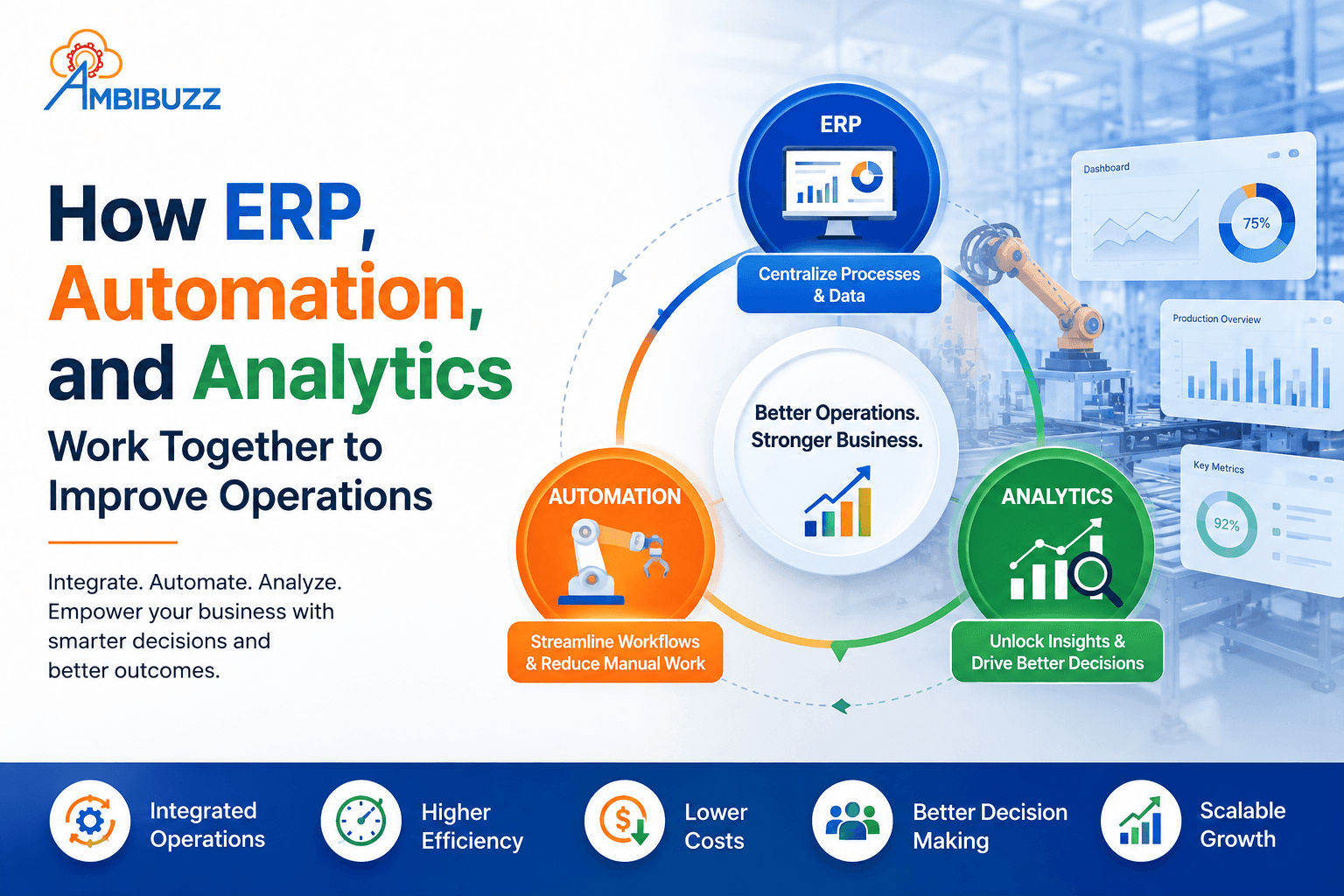
Most businesses in India today are running three separate realities - one inside their ERP, one inside their automation tools, and one inside their analytics dashboards - and then wondering why nothing adds up. This guide breaks down exactly how ERP, automation, and analytics work as a single integrated engine, and why the companies that connect all three are the ones pulling ahead.
Table Of Content
What ERP, Automation, and Analytics Actually Mean - Without the Jargon
How Business Automation Eliminates the Work That Slows You Down
The Integration Effect - What Happens When All Three Work Together
Real-World Scenarios - What This Looks Like in Indian Businesses
ERPNext vs Odoo - Which Open-Source ERP Makes More Sense for You?
How Ambibuzz Builds This Three-Layer Stack for Indian Businesses
Conclusion - The Gap Between Running a Business and Growing One
The Operational Problem No One Wants to Admit
Picture this. A Pune-based manufacturer gets a customer complaint about a delayed shipment. The sales team blames production. Production blames procurement. Procurement says the vendor was not followed up on time. The finance team has no visibility into what happened and when. The owner calls a meeting, and four hours later, everyone agrees to "be more careful next time."
This is not a people problem. It is a systems problem.
When your ERP is not talking to your automation workflows, and your automation workflows are not feeding your analytics dashboard, you do not have a business operations system - you have three separate systems that each tell a different version of the truth. Decisions get made on instinct, on WhatsApp forwards, and on last quarter's data. Problems get fixed after they have already cost you money.
ERP platforms with embedded intelligence deliver 35% improvements in decision-making speed. But that only happens when ERP, automation, and analytics are working as one connected layer - not as three separate investments that sit in different corners of your business. Anchor Group
What ERP, Automation, and Analytics Actually Mean - Without the Jargon
Before getting into how they work together, it helps to be clear about what each one actually does.
An ERP - Enterprise Resource Planning - is the central nervous system of your business. It stores and manages data across every function: procurement, inventory, production, sales, finance, HR, and more. Think of it as the single source of truth for everything that happens in your company. When someone raises a purchase order, generates an invoice, or moves stock from one warehouse to another, that transaction lives in the ERP.
Business automation is the set of rules, workflows, and triggers that remove manual steps from your operations. Instead of someone manually sending a payment reminder to a vendor or updating a spreadsheet after a production run, automation handles it instantly - and consistently. It connects actions across systems without requiring a human to be the messenger.
Analytics is the intelligence layer. It takes the data your ERP captures and the actions your automation executes, and turns them into patterns, trends, alerts, and predictions. It answers questions like - which product line is losing margin, which supplier is consistently late, and what is likely to happen to your cash flow next month if order volumes stay where they are.
Separately, each one has value. Together, they become a genuine competitive advantage.
Why These Three Cannot Work in Isolation
Here is a scenario that plays out across hundreds of Indian factories and trading businesses every day.
A company implements an ERP. They capture orders, manage inventory, run payroll. Good start. But reports are still being pulled manually. Someone exports data to Excel, formats it, emails it to the management team, and by the time the leadership reads it, the data is already two weeks old. The ERP has data, but no one can use it fast enough to make a difference.
Another company invests in automation. They set up bots for invoice processing and auto-reminders for collections. Productivity improves. But the automation runs on its own logic, disconnected from the ERP. When the ERP data changes - when a customer's credit limit is revised or a product is discontinued - the automation does not know. It keeps firing reminders for accounts that have already been resolved, or approving orders for products you no longer stock.
A third company buys a business analytics platform. Beautiful dashboards. Excellent charts. But the data flowing into those dashboards comes from four different systems that do not sync properly. The inventory number in the analytics tool disagrees with the inventory number in the ERP. Now you have an analytics tool that nobody trusts.
70% of companies using ERP analytics report better decision-making. But that figure assumes the analytics is actually connected to accurate, live ERP data - not a disconnected tool pulling from stale exports. solutionsystems
The reason all three must work together is simple: ERP creates the data, automation ensures it is current and acted upon, and analytics ensures it is interpreted correctly. Remove any one link and the chain breaks.
How ERP Becomes the Foundation of Everything
The ERP is where it all begins. Every business process - from a customer placing an order to a vendor delivering raw material - generates a transaction, and that transaction needs a home. Without a well-implemented ERP, you have fragmented data living in Tally, in Excel, in email threads, and in the memory of your operations manager who has been with the company for twelve years.
An ERP system brings together core business functions into one centralised platform. Instead of storing data in isolated systems, businesses manage everything - from supply chain to customer relationships and financial operations - through a unified digital environment, ensuring all teams work from a single, accurate data source. Jacopo Solutions
For Indian manufacturing companies specifically, ERP does several things that nothing else can replicate. It manages BOMs (Bill of Materials), production work orders, material requisitions, quality checkpoints, subcontracting workflows, and dispatch documentation - all within a single system. When an ERP is implemented correctly, you can trace every rupee of cost and every hour of labor back to the order that created it.
Manufacturing companies account for 47% of organizations looking to purchase ERP software, making it the largest buyer category - reflecting the complex operational requirements around production scheduling, inventory management, and quality control that demand sophisticated ERP functionality. Anchor Group
For cloud ERP solutions in India, the advantage is even more pronounced. A cloud ERP implementation means your plant manager in Nashik, your finance team in Mumbai, and your sales team visiting clients in Delhi are all looking at the same real-time data - without VPNs, without manual syncing, without calling each other to confirm stock levels.
But an ERP alone is not enough. Data sitting in a database is just data. What transforms it into operational value is what comes next.
How Business Automation Eliminates the Work That Slows You Down
Here is a truth that most businesses do not want to look at directly. A significant portion of your team's working hours every day goes toward tasks that add zero creative or strategic value - tasks that simply move information from one place to another, remind someone about something that was already agreed, or reformat a number that already exists somewhere else.
That is not a criticism of your team. It is a criticism of your systems.
Business automation is what you build on top of an ERP to eliminate this friction. It covers everything from automated purchase order generation when stock drops below a reorder point, to auto-approval workflows for expenses below a certain threshold, to triggered alerts when a customer's outstanding balance crosses a credit limit, to scheduled reports that land in a manager's inbox every Monday morning without anyone having to generate them.
The rise of hyperautomation - combining robotic process automation, AI, and machine learning - is designed to reduce human involvement in routine tasks, boosting efficiency across the board. Washington Frank
For Indian SMEs and mid-sized manufacturers, the automation wins are often immediate and visible. A food manufacturing client of Ambibuzz went from 90% paper-based operations to nearly paperless - with 100% real-time KPI-driven practice - after implementing an integrated ERP and automation stack. Another manufacturing client achieved a 50% drop in human mistakes in order processing through complete traceability built into automated workflows.
The most powerful automation, however, is not just about eliminating steps. It is about ensuring that when something important happens in your ERP, the right action is taken automatically and the right person is informed immediately. That connection between ERP events and automated responses is what makes a business genuinely responsive instead of merely reactive.
From generating purchase orders to reconciling finances, repetitive steps will be heavily automated. Intelligent ERP systems will highlight issues before they escalate, improving quality control. Ngenioussolutions
How Analytics Turns All That Data Into Actual Decisions
Once your ERP is capturing accurate, real-time data and your automation is ensuring that data flows cleanly and triggers the right actions, you have something genuinely valuable - a rich, reliable data foundation. Analytics is how you make that foundation work for strategy, not just operations.
Indian businesses are looking for ERP solutions that can help them better understand their data and make more informed business decisions. This has led to the development of ERP solutions that offer advanced analytics and BI capabilities, including predictive analytics, machine learning, and artificial intelligence. Statista
Business analytics software layered on top of an integrated ERP gives you several things that spreadsheets and intuition never can.
First, it gives you real-time dashboards - live visibility into revenue, costs, inventory turns, production efficiency, and customer performance - without anyone having to compile a report. The numbers update as transactions happen.
Second, it gives you predictive power. AI analytics platforms can look at your historical sales patterns, current order pipeline, inventory positions, and supplier lead times, and tell you what your stock situation will look like in six weeks - before you run into a shortage. They can flag a customer who is showing early signs of churn based on order frequency, or identify a product line where margin is silently eroding.
Third, and most importantly for leadership teams, business intelligence tools translate operational data into financial outcomes. Instead of a plant manager knowing that OEE dropped last week and a finance director separately wondering why margins fell, an integrated analytics layer connects these two facts and shows the causal relationship.
Organizations implementing AI-enabled ERP systems report 20% improvement in forecasting accuracy and 15% reduction in operational costs. Anchor Group
Strong analytics support improved financial management, tighter inventory control, and more effective supply chain management, resulting in greater efficiency, lower costs, and better customer outcomes. Jacopo Solutions
The Integration Effect - What Happens When All Three Work Together
When ERP, automation, and analytics run as a unified system rather than three separate tools, the business effect is qualitatively different - not just incrementally better.
Consider a garment manufacturer running this integrated stack. A sales order comes in. The ERP immediately checks stock availability, updates the production plan if new fabric needs to be sourced, and triggers a purchase order to the preferred vendor. The vendor receives an automated email. The finance team sees the committed cost in real-time. When the fabric arrives and the production order is completed, the analytics dashboard updates OEE, tracks cost against target, and flags if the batch came in over budget - all automatically.
The owner can look at a single dashboard from their phone and see: orders received today, production status, pending collections, cash position, and whether this week is on track to meet the monthly revenue target. No one had to compile anything. No one had to send a morning report.
Integrated platforms achieve 99%+ order-to-cash accuracy versus mid-90s percent in disconnected systems. Financial close cycles reduce by 50% through automation. Anchor Group
This is the integration effect. It is not just efficiency. It is a fundamentally different way of running a business - one where leadership has complete, current, accurate information at all times, and where operational exceptions surface automatically rather than being discovered too late.
AI-powered ERP systems improve operational efficiency by 40%. That number only materializes when the three layers - ERP data, automation, and analytics - are genuinely integrated, not bolted together as an afterthought. solutionsystems
Real-World Scenarios - What This Looks Like in Indian Businesses
For a manufacturing company: The ERP manages BOMs, work orders, and inventory. Automation triggers procurement when raw material falls below safety stock, routes quality rejections to a supervisor for immediate review, and sends dispatch alerts to the customer. Analytics tracks OEE by shift, monitors scrap rates by production line, and forecasts raw material requirements for the next quarter. Leadership sees a consolidated view of plant performance, cost per unit, and on-time delivery from a single dashboard.
For an FMCG or food business: The ERP manages batch traceability, expiry-based inventory rotation, and subcontracting workflows. Automation handles sales order confirmations, generates picking lists for the warehouse team, and triggers payment reminders for distributors. Analytics shows revenue by SKU, distributor performance rankings, and flags products where shelf life is becoming a risk. The sales director can see which distributor territory is underperforming before month-end.
For a B2B services or trading company: The ERP manages customer accounts, vendor payments, and procurement. Automation handles repeat purchase orders for fast-moving items, sends invoice-due alerts to the collections team, and routes escalations when a supplier is late. Analytics tracks gross margin by customer, forecasts next month's payables and receivables, and identifies which customers are the most profitable - not just the highest revenue.
In each of these cases, the value is not any single system. It is the connection between them.
Common Reasons Indian Businesses Get This Wrong
Despite all the talk about digital transformation, most Indian businesses invest in ERP, automation, or analytics separately - and then wonder why the ROI is not materializing. Here are the most common mistakes.
The first mistake is buying an ERP and then stopping. An ERP that simply replaces your old registers and Tally sheets without automation or analytics layered on top is an expensive data entry system. The real value of an ERP only emerges when the data it captures is being acted on automatically and interpreted intelligently.
The second mistake is automating broken processes. Before you automate a workflow, you need to be sure that workflow is the right workflow. Automating a flawed approval process makes your mistakes happen faster, not slower. Always map your processes correctly before automating them.
The third mistake is choosing analytics tools that do not integrate with your ERP. A standalone BI tool that requires manual data uploads from your ERP is not an analytics platform - it is a charting tool. Real-time insights require real-time data integration.
The fourth mistake is under-investing in implementation. Companies using consultants achieve 85% success rates versus 27-30% industry baseline performance. This 55-percentage-point gap reflects advantages in proven methodologies, technical expertise, and industry experience that internal teams typically cannot match. Choosing a certified ERPNext implementation partner or an experienced Odoo implementation company in India - rather than trying to do it in-house - is often the difference between a transformation that works and one that stalls. Anchor Group
The fifth mistake is treating this as a one-time project rather than a continuous practice. ERP customization services, integration services, and analytics configurations all need to evolve as your business evolves. Digital transformation is not a destination. It is an ongoing investment.
What to Look for in an ERP Solutions Company in India
If you are looking to implement this three-layer stack for the first time - or to upgrade a disconnected set of systems into an integrated one - the choice of implementation partner matters enormously.
Here is what to look for in a serious ERP solutions company in India.
Industry experience in your sector matters more than general ERP expertise. An ERP implementation for a pharma company is fundamentally different from one for a garment manufacturer or a logistics business. Your partner should have live references in your industry.
Certified partnership status is a trust signal that cannot be faked. Whether it is a certified ERPNext partner, a Frappe framework development services provider, or an Odoo implementation company in India - certification means the partner has been evaluated by the platform vendor and meets defined standards of competency.
Custom ERP development capability is important because no standard ERP covers every process exactly as your business runs it. You want a partner who can build custom ERPNext apps, extend existing modules, and develop integrations without creating fragile workarounds.
Post-implementation support is where most of the long-term value is created and where most implementations fall apart. Look for a partner who offers ongoing ERP consulting services, not just a one-time delivery team.
And finally, analytics capability within the same partner ecosystem matters more than people realize. When your ERP implementation partner also builds your analytics layer, the integration is seamless - there are no finger-pointing conversations between two vendors when something does not work.
ERPNext vs Odoo - Which Open-Source ERP Makes More Sense for You?
This is one of the most common questions Indian businesses ask when evaluating ERP solutions. Both ERPNext and Odoo are open-source, both are highly customizable, and both have strong implementation ecosystems in India. But they are not the same.
ERPNext, built on the Frappe framework, is designed from the ground up as a fully integrated business platform. It covers manufacturing, accounting, HR, CRM, projects, assets, and more - all in a single unified codebase. For Indian SMEs and manufacturers who want deep integration without buying multiple modules from different vendors, ERPNext is often the stronger choice. Its open-source nature also means no per-user licensing costs, which is a significant financial advantage for growing businesses.
Odoo is a more modular platform. You start with a core set of apps and add modules as needed. It has a larger global ecosystem, a wider range of third-party modules, and an extremely active developer community. For businesses that need highly specific functionality - a specialized e-commerce integration, a niche industry module, or an advanced POS setup - Odoo's marketplace breadth can be an advantage.
The honest answer is that neither is universally better. The right choice depends on your industry, your process complexity, your internal IT capability, and the quality of the implementation partner you choose. A certified ERPNext partner who understands your industry will deliver better outcomes than a technically perfect Odoo implementation by a team that does not understand manufacturing.
What matters more than the platform is the implementation quality, the post-go-live support, and the ability to extend the system as your business grows.
How Ambibuzz Builds This Three-Layer Stack for Indian Businesses
Ambibuzz is an ERP solutions company in India that is a certified Frappe partner and Odoo learning partner - which means they have been evaluated and recognized for their implementation competency on both major open-source ERP platforms. They work with businesses across manufacturing, FMCG, food processing, logistics, pharmaceuticals, automotive, and more.
What makes Ambibuzz's approach different is that they do not just implement an ERP and hand it over. They build the full three-layer stack - ERP foundation, automation workflows, and analytics intelligence - as a single integrated engagement.
On the ERP side, Ambibuzz implements ERPNext-powered solutions that cover every business function - from procurement and production to sales, HR, and finance - with the customization and integration work needed to match how your business actually runs. This includes ERP customization services for industry-specific workflows, ERP integration services to connect the ERP with IoT devices, e-commerce platforms, third-party logistics systems, or payment gateways, and ongoing ERP consulting services to keep the system aligned with your evolving operations.
On the automation side, the AmPower suite delivers purpose-built automation tools for specific business functions. AmPower OrderIT replaces paper-based B2B ordering with a seamless digital platform. AmPower FaceIT automates HR workflows - attendance, leave management, expense approvals - powered by ERPNext HRMS. AmPower BuzzIT gives leadership real-time MIS on mobile, so critical business information is never more than a tap away.
On the analytics side, AmPower DeepMatrix is Ambibuzz's AI-powered business intelligence and analytics platform. It transforms the data captured across ERP and automation workflows into actionable dashboards, predictive forecasts, demand planning insights, and smart alerts. When a key metric crosses a threshold, the system flags it. When sales are trending toward a shortfall, the system surfaces it before month-end. When inventory is heading toward a stockout, the system alerts procurement before the line goes down.
The result is exactly the integrated stack described throughout this blog - ERP as the data foundation, automation as the operational execution layer, and analytics as the intelligence engine. All three built by the same team, on the same platform, for your specific business.
Conclusion - The Gap Between Running a Business and Growing One
There is a real difference between running a business and growing one. Running a business means managing the chaos - chasing payments, firefighting production issues, manually reconciling accounts, and spending Friday afternoons on reports that reflect Tuesday's reality.
Growing a business means having the visibility, the speed, and the intelligence to make good decisions before problems become crises - and to identify opportunities before competitors do.
Cloud ERP systems play a key role in digital transformation by integrating cutting-edge technology into all business functions to improve daily operations, boost revenue, and increase competitiveness - all while increasing employee productivity and improving customer service. NetSuite
The businesses that will define Indian manufacturing and enterprise in the next decade are not necessarily the largest or the best-funded. They are the ones that connected their data, automated their operations, and built the intelligence layer that lets them act faster and smarter than everyone around them.
ERP, automation, and analytics are not three separate software purchases. They are one integrated decision - the decision to run your business on clarity instead of confusion.
Ambibuzz builds that clarity for Indian businesses. If you are ready to move from three disconnected systems to one integrated operating platform, request a free demo and see what it looks like when ERP, automation, and analytics finally work together.
The Operational Problem No One Wants to Admit
Picture this. A Pune-based manufacturer gets a customer complaint about a delayed shipment. The sales team blames production. Production blames procurement. Procurement says the vendor was not followed up on time. The finance team has no visibility into what happened and when. The owner calls a meeting, and four hours later, everyone agrees to "be more careful next time."
This is not a people problem. It is a systems problem.
When your ERP is not talking to your automation workflows, and your automation workflows are not feeding your analytics dashboard, you do not have a business operations system - you have three separate systems that each tell a different version of the truth. Decisions get made on instinct, on WhatsApp forwards, and on last quarter's data. Problems get fixed after they have already cost you money.
ERP platforms with embedded intelligence deliver 35% improvements in decision-making speed. But that only happens when ERP, automation, and analytics are working as one connected layer - not as three separate investments that sit in different corners of your business. Anchor Group
What ERP, Automation, and Analytics Actually Mean - Without the Jargon
Before getting into how they work together, it helps to be clear about what each one actually does.
An ERP - Enterprise Resource Planning - is the central nervous system of your business. It stores and manages data across every function: procurement, inventory, production, sales, finance, HR, and more. Think of it as the single source of truth for everything that happens in your company. When someone raises a purchase order, generates an invoice, or moves stock from one warehouse to another, that transaction lives in the ERP.
Business automation is the set of rules, workflows, and triggers that remove manual steps from your operations. Instead of someone manually sending a payment reminder to a vendor or updating a spreadsheet after a production run, automation handles it instantly - and consistently. It connects actions across systems without requiring a human to be the messenger.
Analytics is the intelligence layer. It takes the data your ERP captures and the actions your automation executes, and turns them into patterns, trends, alerts, and predictions. It answers questions like - which product line is losing margin, which supplier is consistently late, and what is likely to happen to your cash flow next month if order volumes stay where they are.
Separately, each one has value. Together, they become a genuine competitive advantage.
Why These Three Cannot Work in Isolation
Here is a scenario that plays out across hundreds of Indian factories and trading businesses every day.
A company implements an ERP. They capture orders, manage inventory, run payroll. Good start. But reports are still being pulled manually. Someone exports data to Excel, formats it, emails it to the management team, and by the time the leadership reads it, the data is already two weeks old. The ERP has data, but no one can use it fast enough to make a difference.
Another company invests in automation. They set up bots for invoice processing and auto-reminders for collections. Productivity improves. But the automation runs on its own logic, disconnected from the ERP. When the ERP data changes - when a customer's credit limit is revised or a product is discontinued - the automation does not know. It keeps firing reminders for accounts that have already been resolved, or approving orders for products you no longer stock.
A third company buys a business analytics platform. Beautiful dashboards. Excellent charts. But the data flowing into those dashboards comes from four different systems that do not sync properly. The inventory number in the analytics tool disagrees with the inventory number in the ERP. Now you have an analytics tool that nobody trusts.
70% of companies using ERP analytics report better decision-making. But that figure assumes the analytics is actually connected to accurate, live ERP data - not a disconnected tool pulling from stale exports. solutionsystems
The reason all three must work together is simple: ERP creates the data, automation ensures it is current and acted upon, and analytics ensures it is interpreted correctly. Remove any one link and the chain breaks.
How ERP Becomes the Foundation of Everything
The ERP is where it all begins. Every business process - from a customer placing an order to a vendor delivering raw material - generates a transaction, and that transaction needs a home. Without a well-implemented ERP, you have fragmented data living in Tally, in Excel, in email threads, and in the memory of your operations manager who has been with the company for twelve years.
An ERP system brings together core business functions into one centralised platform. Instead of storing data in isolated systems, businesses manage everything - from supply chain to customer relationships and financial operations - through a unified digital environment, ensuring all teams work from a single, accurate data source. Jacopo Solutions
For Indian manufacturing companies specifically, ERP does several things that nothing else can replicate. It manages BOMs (Bill of Materials), production work orders, material requisitions, quality checkpoints, subcontracting workflows, and dispatch documentation - all within a single system. When an ERP is implemented correctly, you can trace every rupee of cost and every hour of labor back to the order that created it.
Manufacturing companies account for 47% of organizations looking to purchase ERP software, making it the largest buyer category - reflecting the complex operational requirements around production scheduling, inventory management, and quality control that demand sophisticated ERP functionality. Anchor Group
For cloud ERP solutions in India, the advantage is even more pronounced. A cloud ERP implementation means your plant manager in Nashik, your finance team in Mumbai, and your sales team visiting clients in Delhi are all looking at the same real-time data - without VPNs, without manual syncing, without calling each other to confirm stock levels.
But an ERP alone is not enough. Data sitting in a database is just data. What transforms it into operational value is what comes next.
How Business Automation Eliminates the Work That Slows You Down
Here is a truth that most businesses do not want to look at directly. A significant portion of your team's working hours every day goes toward tasks that add zero creative or strategic value - tasks that simply move information from one place to another, remind someone about something that was already agreed, or reformat a number that already exists somewhere else.
That is not a criticism of your team. It is a criticism of your systems.
Business automation is what you build on top of an ERP to eliminate this friction. It covers everything from automated purchase order generation when stock drops below a reorder point, to auto-approval workflows for expenses below a certain threshold, to triggered alerts when a customer's outstanding balance crosses a credit limit, to scheduled reports that land in a manager's inbox every Monday morning without anyone having to generate them.
The rise of hyperautomation - combining robotic process automation, AI, and machine learning - is designed to reduce human involvement in routine tasks, boosting efficiency across the board. Washington Frank
For Indian SMEs and mid-sized manufacturers, the automation wins are often immediate and visible. A food manufacturing client of Ambibuzz went from 90% paper-based operations to nearly paperless - with 100% real-time KPI-driven practice - after implementing an integrated ERP and automation stack. Another manufacturing client achieved a 50% drop in human mistakes in order processing through complete traceability built into automated workflows.
The most powerful automation, however, is not just about eliminating steps. It is about ensuring that when something important happens in your ERP, the right action is taken automatically and the right person is informed immediately. That connection between ERP events and automated responses is what makes a business genuinely responsive instead of merely reactive.
From generating purchase orders to reconciling finances, repetitive steps will be heavily automated. Intelligent ERP systems will highlight issues before they escalate, improving quality control. Ngenioussolutions
How Analytics Turns All That Data Into Actual Decisions
Once your ERP is capturing accurate, real-time data and your automation is ensuring that data flows cleanly and triggers the right actions, you have something genuinely valuable - a rich, reliable data foundation. Analytics is how you make that foundation work for strategy, not just operations.
Indian businesses are looking for ERP solutions that can help them better understand their data and make more informed business decisions. This has led to the development of ERP solutions that offer advanced analytics and BI capabilities, including predictive analytics, machine learning, and artificial intelligence. Statista
Business analytics software layered on top of an integrated ERP gives you several things that spreadsheets and intuition never can.
First, it gives you real-time dashboards - live visibility into revenue, costs, inventory turns, production efficiency, and customer performance - without anyone having to compile a report. The numbers update as transactions happen.
Second, it gives you predictive power. AI analytics platforms can look at your historical sales patterns, current order pipeline, inventory positions, and supplier lead times, and tell you what your stock situation will look like in six weeks - before you run into a shortage. They can flag a customer who is showing early signs of churn based on order frequency, or identify a product line where margin is silently eroding.
Third, and most importantly for leadership teams, business intelligence tools translate operational data into financial outcomes. Instead of a plant manager knowing that OEE dropped last week and a finance director separately wondering why margins fell, an integrated analytics layer connects these two facts and shows the causal relationship.
Organizations implementing AI-enabled ERP systems report 20% improvement in forecasting accuracy and 15% reduction in operational costs. Anchor Group
Strong analytics support improved financial management, tighter inventory control, and more effective supply chain management, resulting in greater efficiency, lower costs, and better customer outcomes. Jacopo Solutions
The Integration Effect - What Happens When All Three Work Together
When ERP, automation, and analytics run as a unified system rather than three separate tools, the business effect is qualitatively different - not just incrementally better.
Consider a garment manufacturer running this integrated stack. A sales order comes in. The ERP immediately checks stock availability, updates the production plan if new fabric needs to be sourced, and triggers a purchase order to the preferred vendor. The vendor receives an automated email. The finance team sees the committed cost in real-time. When the fabric arrives and the production order is completed, the analytics dashboard updates OEE, tracks cost against target, and flags if the batch came in over budget - all automatically.
The owner can look at a single dashboard from their phone and see: orders received today, production status, pending collections, cash position, and whether this week is on track to meet the monthly revenue target. No one had to compile anything. No one had to send a morning report.
Integrated platforms achieve 99%+ order-to-cash accuracy versus mid-90s percent in disconnected systems. Financial close cycles reduce by 50% through automation. Anchor Group
This is the integration effect. It is not just efficiency. It is a fundamentally different way of running a business - one where leadership has complete, current, accurate information at all times, and where operational exceptions surface automatically rather than being discovered too late.
AI-powered ERP systems improve operational efficiency by 40%. That number only materializes when the three layers - ERP data, automation, and analytics - are genuinely integrated, not bolted together as an afterthought. solutionsystems
Real-World Scenarios - What This Looks Like in Indian Businesses
For a manufacturing company: The ERP manages BOMs, work orders, and inventory. Automation triggers procurement when raw material falls below safety stock, routes quality rejections to a supervisor for immediate review, and sends dispatch alerts to the customer. Analytics tracks OEE by shift, monitors scrap rates by production line, and forecasts raw material requirements for the next quarter. Leadership sees a consolidated view of plant performance, cost per unit, and on-time delivery from a single dashboard.
For an FMCG or food business: The ERP manages batch traceability, expiry-based inventory rotation, and subcontracting workflows. Automation handles sales order confirmations, generates picking lists for the warehouse team, and triggers payment reminders for distributors. Analytics shows revenue by SKU, distributor performance rankings, and flags products where shelf life is becoming a risk. The sales director can see which distributor territory is underperforming before month-end.
For a B2B services or trading company: The ERP manages customer accounts, vendor payments, and procurement. Automation handles repeat purchase orders for fast-moving items, sends invoice-due alerts to the collections team, and routes escalations when a supplier is late. Analytics tracks gross margin by customer, forecasts next month's payables and receivables, and identifies which customers are the most profitable - not just the highest revenue.
In each of these cases, the value is not any single system. It is the connection between them.
Common Reasons Indian Businesses Get This Wrong
Despite all the talk about digital transformation, most Indian businesses invest in ERP, automation, or analytics separately - and then wonder why the ROI is not materializing. Here are the most common mistakes.
The first mistake is buying an ERP and then stopping. An ERP that simply replaces your old registers and Tally sheets without automation or analytics layered on top is an expensive data entry system. The real value of an ERP only emerges when the data it captures is being acted on automatically and interpreted intelligently.
The second mistake is automating broken processes. Before you automate a workflow, you need to be sure that workflow is the right workflow. Automating a flawed approval process makes your mistakes happen faster, not slower. Always map your processes correctly before automating them.
The third mistake is choosing analytics tools that do not integrate with your ERP. A standalone BI tool that requires manual data uploads from your ERP is not an analytics platform - it is a charting tool. Real-time insights require real-time data integration.
The fourth mistake is under-investing in implementation. Companies using consultants achieve 85% success rates versus 27-30% industry baseline performance. This 55-percentage-point gap reflects advantages in proven methodologies, technical expertise, and industry experience that internal teams typically cannot match. Choosing a certified ERPNext implementation partner or an experienced Odoo implementation company in India - rather than trying to do it in-house - is often the difference between a transformation that works and one that stalls. Anchor Group
The fifth mistake is treating this as a one-time project rather than a continuous practice. ERP customization services, integration services, and analytics configurations all need to evolve as your business evolves. Digital transformation is not a destination. It is an ongoing investment.
What to Look for in an ERP Solutions Company in India
If you are looking to implement this three-layer stack for the first time - or to upgrade a disconnected set of systems into an integrated one - the choice of implementation partner matters enormously.
Here is what to look for in a serious ERP solutions company in India.
Industry experience in your sector matters more than general ERP expertise. An ERP implementation for a pharma company is fundamentally different from one for a garment manufacturer or a logistics business. Your partner should have live references in your industry.
Certified partnership status is a trust signal that cannot be faked. Whether it is a certified ERPNext partner, a Frappe framework development services provider, or an Odoo implementation company in India - certification means the partner has been evaluated by the platform vendor and meets defined standards of competency.
Custom ERP development capability is important because no standard ERP covers every process exactly as your business runs it. You want a partner who can build custom ERPNext apps, extend existing modules, and develop integrations without creating fragile workarounds.
Post-implementation support is where most of the long-term value is created and where most implementations fall apart. Look for a partner who offers ongoing ERP consulting services, not just a one-time delivery team.
And finally, analytics capability within the same partner ecosystem matters more than people realize. When your ERP implementation partner also builds your analytics layer, the integration is seamless - there are no finger-pointing conversations between two vendors when something does not work.
ERPNext vs Odoo - Which Open-Source ERP Makes More Sense for You?
This is one of the most common questions Indian businesses ask when evaluating ERP solutions. Both ERPNext and Odoo are open-source, both are highly customizable, and both have strong implementation ecosystems in India. But they are not the same.
ERPNext, built on the Frappe framework, is designed from the ground up as a fully integrated business platform. It covers manufacturing, accounting, HR, CRM, projects, assets, and more - all in a single unified codebase. For Indian SMEs and manufacturers who want deep integration without buying multiple modules from different vendors, ERPNext is often the stronger choice. Its open-source nature also means no per-user licensing costs, which is a significant financial advantage for growing businesses.
Odoo is a more modular platform. You start with a core set of apps and add modules as needed. It has a larger global ecosystem, a wider range of third-party modules, and an extremely active developer community. For businesses that need highly specific functionality - a specialized e-commerce integration, a niche industry module, or an advanced POS setup - Odoo's marketplace breadth can be an advantage.
The honest answer is that neither is universally better. The right choice depends on your industry, your process complexity, your internal IT capability, and the quality of the implementation partner you choose. A certified ERPNext partner who understands your industry will deliver better outcomes than a technically perfect Odoo implementation by a team that does not understand manufacturing.
What matters more than the platform is the implementation quality, the post-go-live support, and the ability to extend the system as your business grows.
How Ambibuzz Builds This Three-Layer Stack for Indian Businesses
Ambibuzz is an ERP solutions company in India that is a certified Frappe partner and Odoo learning partner - which means they have been evaluated and recognized for their implementation competency on both major open-source ERP platforms. They work with businesses across manufacturing, FMCG, food processing, logistics, pharmaceuticals, automotive, and more.
What makes Ambibuzz's approach different is that they do not just implement an ERP and hand it over. They build the full three-layer stack - ERP foundation, automation workflows, and analytics intelligence - as a single integrated engagement.
On the ERP side, Ambibuzz implements ERPNext-powered solutions that cover every business function - from procurement and production to sales, HR, and finance - with the customization and integration work needed to match how your business actually runs. This includes ERP customization services for industry-specific workflows, ERP integration services to connect the ERP with IoT devices, e-commerce platforms, third-party logistics systems, or payment gateways, and ongoing ERP consulting services to keep the system aligned with your evolving operations.
On the automation side, the AmPower suite delivers purpose-built automation tools for specific business functions. AmPower OrderIT replaces paper-based B2B ordering with a seamless digital platform. AmPower FaceIT automates HR workflows - attendance, leave management, expense approvals - powered by ERPNext HRMS. AmPower BuzzIT gives leadership real-time MIS on mobile, so critical business information is never more than a tap away.
On the analytics side, AmPower DeepMatrix is Ambibuzz's AI-powered business intelligence and analytics platform. It transforms the data captured across ERP and automation workflows into actionable dashboards, predictive forecasts, demand planning insights, and smart alerts. When a key metric crosses a threshold, the system flags it. When sales are trending toward a shortfall, the system surfaces it before month-end. When inventory is heading toward a stockout, the system alerts procurement before the line goes down.
The result is exactly the integrated stack described throughout this blog - ERP as the data foundation, automation as the operational execution layer, and analytics as the intelligence engine. All three built by the same team, on the same platform, for your specific business.
Conclusion - The Gap Between Running a Business and Growing One
There is a real difference between running a business and growing one. Running a business means managing the chaos - chasing payments, firefighting production issues, manually reconciling accounts, and spending Friday afternoons on reports that reflect Tuesday's reality.
Growing a business means having the visibility, the speed, and the intelligence to make good decisions before problems become crises - and to identify opportunities before competitors do.
Cloud ERP systems play a key role in digital transformation by integrating cutting-edge technology into all business functions to improve daily operations, boost revenue, and increase competitiveness - all while increasing employee productivity and improving customer service. NetSuite
The businesses that will define Indian manufacturing and enterprise in the next decade are not necessarily the largest or the best-funded. They are the ones that connected their data, automated their operations, and built the intelligence layer that lets them act faster and smarter than everyone around them.
ERP, automation, and analytics are not three separate software purchases. They are one integrated decision - the decision to run your business on clarity instead of confusion.
Ambibuzz builds that clarity for Indian businesses. If you are ready to move from three disconnected systems to one integrated operating platform, request a free demo and see what it looks like when ERP, automation, and analytics finally work together.
Table Of Content
What ERP, Automation, and Analytics Actually Mean - Without the Jargon
How Business Automation Eliminates the Work That Slows You Down
The Integration Effect - What Happens When All Three Work Together
Real-World Scenarios - What This Looks Like in Indian Businesses
ERPNext vs Odoo - Which Open-Source ERP Makes More Sense for You?
How Ambibuzz Builds This Three-Layer Stack for Indian Businesses
Conclusion - The Gap Between Running a Business and Growing One
Table Of Content
What ERP, Automation, and Analytics Actually Mean - Without the Jargon
How Business Automation Eliminates the Work That Slows You Down
The Integration Effect - What Happens When All Three Work Together
Real-World Scenarios - What This Looks Like in Indian Businesses
ERPNext vs Odoo - Which Open-Source ERP Makes More Sense for You?
How Ambibuzz Builds This Three-Layer Stack for Indian Businesses
Conclusion - The Gap Between Running a Business and Growing One
Popular Tags
ERP, ERP Software, ERP Solutions, ERP Implementation, ERPNext, Frappe, Odoo, Business Automation, Workflow Automation, Business Analytics, AI Analytics, Business Intelligence, Cloud ERP, Digital Transformation, Manufacturing ERP, ERP for Manufacturing, ERP for SMEs, ERP Consulting, ERP Customization, ERP Integration, ERPNext Partner, Certified ERPNext Partner, Odoo Implementation, Open Source ERP, Enterprise Resource Planning, Manufacturing Software, Inventory Management, Supply Chain Management, Production Planning, Bill of Materials (BOM)