Odoo vs ERPNext in 2026: The ERP Choice That Shapes How You Grow
|
Nidhi Goda
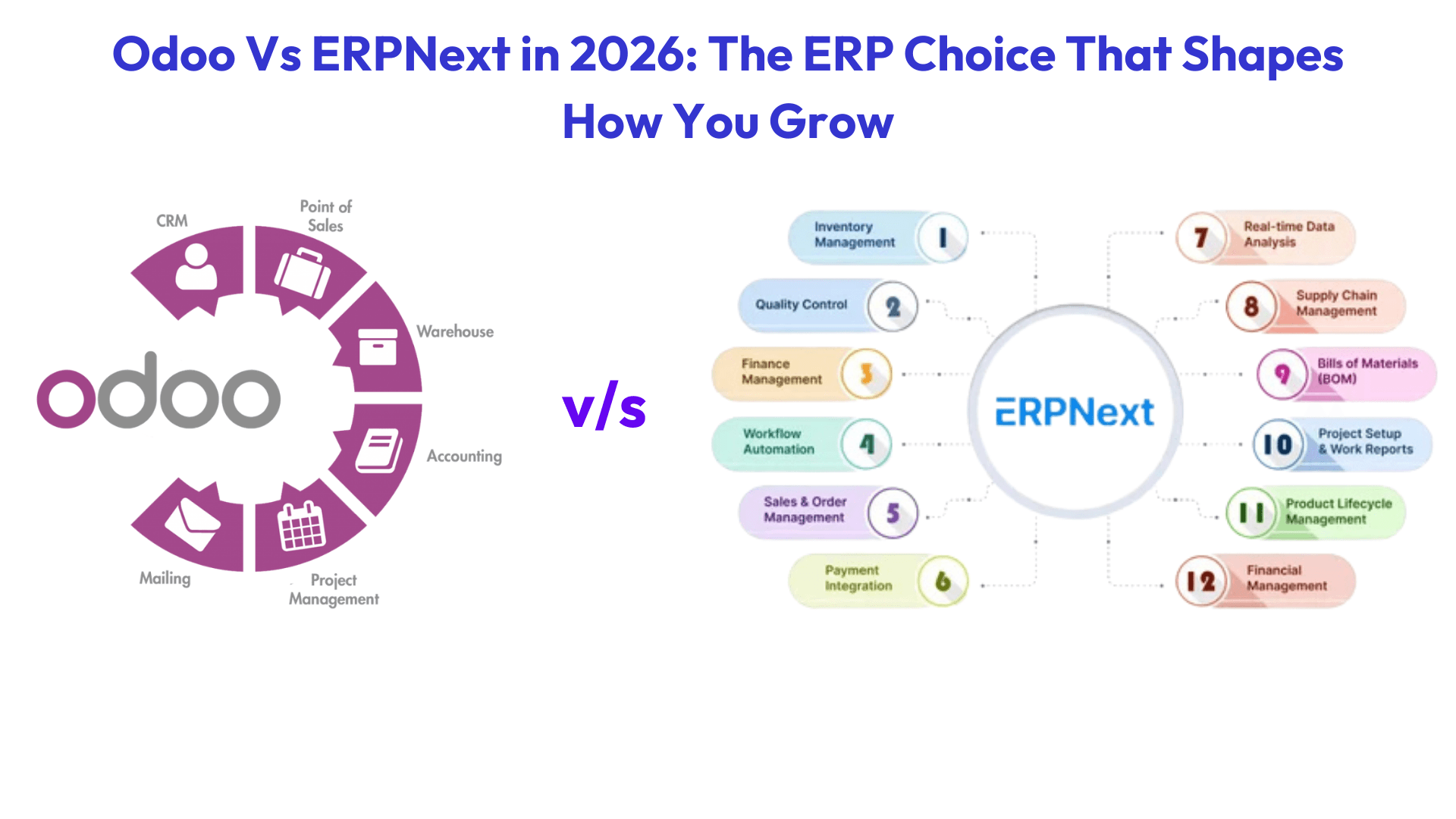
Odoo vs ERPNext in 2026: The ERP Choice That Shapes How You Grow
In 2026, choosing an ERP is no longer a software decision.
It’s a business architecture decision one that quietly influences how your teams collaborate, how fast decisions move, and how scalable (or fragile) your operations become over the next 5–7 years.
Many growing companies reach a point where spreadsheets break down, visibility drops, and teams start working in silos. That’s when ERP enters the conversation and almost inevitably, two names surface:
Odoo and ERPNext
Both are open-source.
Both are proven.
Both power thousands of businesses worldwide.
Yet, once implementation begins, the experience of using them feels fundamentally different.
This isn’t a feature checklist or a vendor comparison. It’s a practical, business-first perspective on how Odoo and ERPNext behave inside real organizations.
Table Of Content
1. Adoption First: Will Your Team Actually Use the System?
No ERP fails because of missing features.Most fail because people stop using them.
Odoo offers a visually rich, modern interface. The design feels polished, dashboards are attractive, and navigation feels familiar to users coming from consumer-grade apps. This often helps with early adoption especially for sales teams, leadership, and client-facing roles.
ERPNext takes a different route. The interface is clean, fast, and purpose-driven. Instead of visual polish, it prioritizes clarity. Users typically understand workflows quickly, and daily operations feel less “heavy.”
In practice:
If experience, presentation, and UI appeal drive adoption → Odoo
If speed, simplicity, and operational clarity matter more → ERPNext
2. Feature Philosophy: Everything Possible vs Everything Necessary
Both platforms cover core ERP needs but their philosophy differs.
Odoo is built as a broad ecosystem. From CRM and manufacturing to marketing automation, POS, subscriptions, and eCommerce there’s a module for nearly everything. The marketplace further extends this with thousands of third-party apps.
This power is ideal for businesses that want to centralize many functions but it can also introduce complexity if not carefully governed.
ERPNext focuses on what most growing businesses actually rely on daily, bringing together essential functions like accounting, inventory, manufacturing, sales, projects, and HR into a single system.
Everything is tightly integrated by default, reducing dependency on add-ons and making the platform simpler to manage.
A simple way to look at it:
Need wide functional coverage → Odoo
Need depth in core operations → ERPNext
3. Manufacturing & Subcontracting: Theory vs Shop-Floor Reality
Manufacturing is where ERPs are truly tested.
Odoo provides advanced manufacturing tools with configurable routings and work centers. It performs well in engineering-heavy or highly customized production environments, though it often requires careful setup and multiple modules.
ERPNext is deeply grounded in day-to-day manufacturing realities. Multi-level BoMs, material planning, subcontracting, inventory valuation, and production planning work cohesively out of the box.
For businesses relying on job work, outsourcing, or vendor collaboration, ERPNext often delivers faster visibility with fewer adjustments.
4. Customization: Freedom vs Control
Customization is both an advantage and a risk.
Odoo offers extensive flexibility. Workflows can be redesigned, automation can be layered deeply, and custom modules can transform the system to match unique business models.
However, that freedom comes with responsibility, higher development costs and long-term maintenance discipline.
ERPNext supports customization too, but encourages standardized processes. Custom changes tend to stay cleaner, easier to maintain, and less likely to disrupt upgrades.
General guideline:
Highly unique workflows and automation-heavy environments → Odoo
Structured operations with controlled customization → ERPNext
5. Reporting, MIS & Decision Intelligence
Dashboards are only useful if they lead to action.
Odoo excels at visually rich reporting, making it ideal for executive reviews and cross-functional visibility.
ERPNext emphasizes operational insight reports that answer practical questions:
Where is inventory stuck?
Which customers are delaying payments?
What production bottleneck is affecting dispatch?
When combined with advanced MIS layers, conversational reporting, and agentic AI workflows, ERPNext becomes a system that supports daily decisions, not just monthly reviews.
6. Cost & Long-Term Ownership
ERP costs are rarely about license fees alone.
Odoo Enterprise pricing scales with users and modules. It delivers strong value but costs rise as complexity increases especially when custom development enters the picture.
ERPNext, particularly when self-hosted, offers a significantly lower total cost of ownership for small and mid-sized businesses. Core functionality remains robust without constant add-on dependency.
Typically:
Cost-sensitive SMEs → ERPNext
Well-funded, fast-scaling companies → Odoo
7. Scalability & Growth Trajectory
Both systems scale but differently.
Odoo handles multi-company, multi-country, and large user bases with ease. It’s often chosen by organizations planning aggressive expansion or diverse business models.
ERPNext scales exceptionally well in manufacturing, distribution, retail, and services. With proper architecture, it supports large operations though enterprise-scale growth requires thoughtful planning.
So, Which ERP Is Better?
There isn’t a universal answer.
The right ERP is the one that aligns with:
Your process maturity
Your team’s working style
Your appetite for complexity
Your long-term growth vision
Choose Odoo if you want | Choose ERPNext if you want: |
|---|---|
Broad feature coverage | Faster implementation |
Strong UI-driven adoption | Lower long-term costs |
Heavy customization capability | Strong manufacturing and accounting |
Enterprise-level flexibility | Clean, efficient operational workflows |
A Final Perspective
ERP decisions fail when businesses choose software before understanding themselves.
At Ambibuzz Technologies LLP, we help organizations evaluate ERPNext and Odoo based on real operational needs, not brand preference or vendor pressure.
Because sometimes, the right ERP becomes obvious only after the right questions are asked.
If you’re stuck choosing between Odoo and ERPNext, feel free to reach out. - https://www.ambibuzz.com/contact
1. Adoption First: Will Your Team Actually Use the System?
No ERP fails because of missing features.Most fail because people stop using them.
Odoo offers a visually rich, modern interface. The design feels polished, dashboards are attractive, and navigation feels familiar to users coming from consumer-grade apps. This often helps with early adoption especially for sales teams, leadership, and client-facing roles.
ERPNext takes a different route. The interface is clean, fast, and purpose-driven. Instead of visual polish, it prioritizes clarity. Users typically understand workflows quickly, and daily operations feel less “heavy.”
In practice:
If experience, presentation, and UI appeal drive adoption → Odoo
If speed, simplicity, and operational clarity matter more → ERPNext
2. Feature Philosophy: Everything Possible vs Everything Necessary
Both platforms cover core ERP needs but their philosophy differs.
Odoo is built as a broad ecosystem. From CRM and manufacturing to marketing automation, POS, subscriptions, and eCommerce there’s a module for nearly everything. The marketplace further extends this with thousands of third-party apps.
This power is ideal for businesses that want to centralize many functions but it can also introduce complexity if not carefully governed.
ERPNext focuses on what most growing businesses actually rely on daily, bringing together essential functions like accounting, inventory, manufacturing, sales, projects, and HR into a single system.
Everything is tightly integrated by default, reducing dependency on add-ons and making the platform simpler to manage.
A simple way to look at it:
Need wide functional coverage → Odoo
Need depth in core operations → ERPNext
3. Manufacturing & Subcontracting: Theory vs Shop-Floor Reality
Manufacturing is where ERPs are truly tested.
Odoo provides advanced manufacturing tools with configurable routings and work centers. It performs well in engineering-heavy or highly customized production environments, though it often requires careful setup and multiple modules.
ERPNext is deeply grounded in day-to-day manufacturing realities. Multi-level BoMs, material planning, subcontracting, inventory valuation, and production planning work cohesively out of the box.
For businesses relying on job work, outsourcing, or vendor collaboration, ERPNext often delivers faster visibility with fewer adjustments.
4. Customization: Freedom vs Control
Customization is both an advantage and a risk.
Odoo offers extensive flexibility. Workflows can be redesigned, automation can be layered deeply, and custom modules can transform the system to match unique business models.
However, that freedom comes with responsibility, higher development costs and long-term maintenance discipline.
ERPNext supports customization too, but encourages standardized processes. Custom changes tend to stay cleaner, easier to maintain, and less likely to disrupt upgrades.
General guideline:
Highly unique workflows and automation-heavy environments → Odoo
Structured operations with controlled customization → ERPNext
5. Reporting, MIS & Decision Intelligence
Dashboards are only useful if they lead to action.
Odoo excels at visually rich reporting, making it ideal for executive reviews and cross-functional visibility.
ERPNext emphasizes operational insight reports that answer practical questions:
Where is inventory stuck?
Which customers are delaying payments?
What production bottleneck is affecting dispatch?
When combined with advanced MIS layers, conversational reporting, and agentic AI workflows, ERPNext becomes a system that supports daily decisions, not just monthly reviews.
6. Cost & Long-Term Ownership
ERP costs are rarely about license fees alone.
Odoo Enterprise pricing scales with users and modules. It delivers strong value but costs rise as complexity increases especially when custom development enters the picture.
ERPNext, particularly when self-hosted, offers a significantly lower total cost of ownership for small and mid-sized businesses. Core functionality remains robust without constant add-on dependency.
Typically:
Cost-sensitive SMEs → ERPNext
Well-funded, fast-scaling companies → Odoo
7. Scalability & Growth Trajectory
Both systems scale but differently.
Odoo handles multi-company, multi-country, and large user bases with ease. It’s often chosen by organizations planning aggressive expansion or diverse business models.
ERPNext scales exceptionally well in manufacturing, distribution, retail, and services. With proper architecture, it supports large operations though enterprise-scale growth requires thoughtful planning.
So, Which ERP Is Better?
There isn’t a universal answer.
The right ERP is the one that aligns with:
Your process maturity
Your team’s working style
Your appetite for complexity
Your long-term growth vision
Choose Odoo if you want | Choose ERPNext if you want: |
|---|---|
Broad feature coverage | Faster implementation |
Strong UI-driven adoption | Lower long-term costs |
Heavy customization capability | Strong manufacturing and accounting |
Enterprise-level flexibility | Clean, efficient operational workflows |
A Final Perspective
ERP decisions fail when businesses choose software before understanding themselves.
At Ambibuzz Technologies LLP, we help organizations evaluate ERPNext and Odoo based on real operational needs, not brand preference or vendor pressure.
Because sometimes, the right ERP becomes obvious only after the right questions are asked.
If you’re stuck choosing between Odoo and ERPNext, feel free to reach out. - https://www.ambibuzz.com/contact
Table Of Content
Table Of Content
Popular Tags