AI in Business Operations: Practical Use Cases for Growing Companies
|
Ambibuzz Team
Introduction
Artificial Intelligence is no longer limited to large enterprises or global technology companies. Indian SMEs across manufacturing, logistics, retail, pharmaceuticals, and professional services are actively using AI to improve operational efficiency, reduce manual work, and make faster business decisions. What was once considered expensive and complex is now practical, accessible, and affordable for growing businesses.
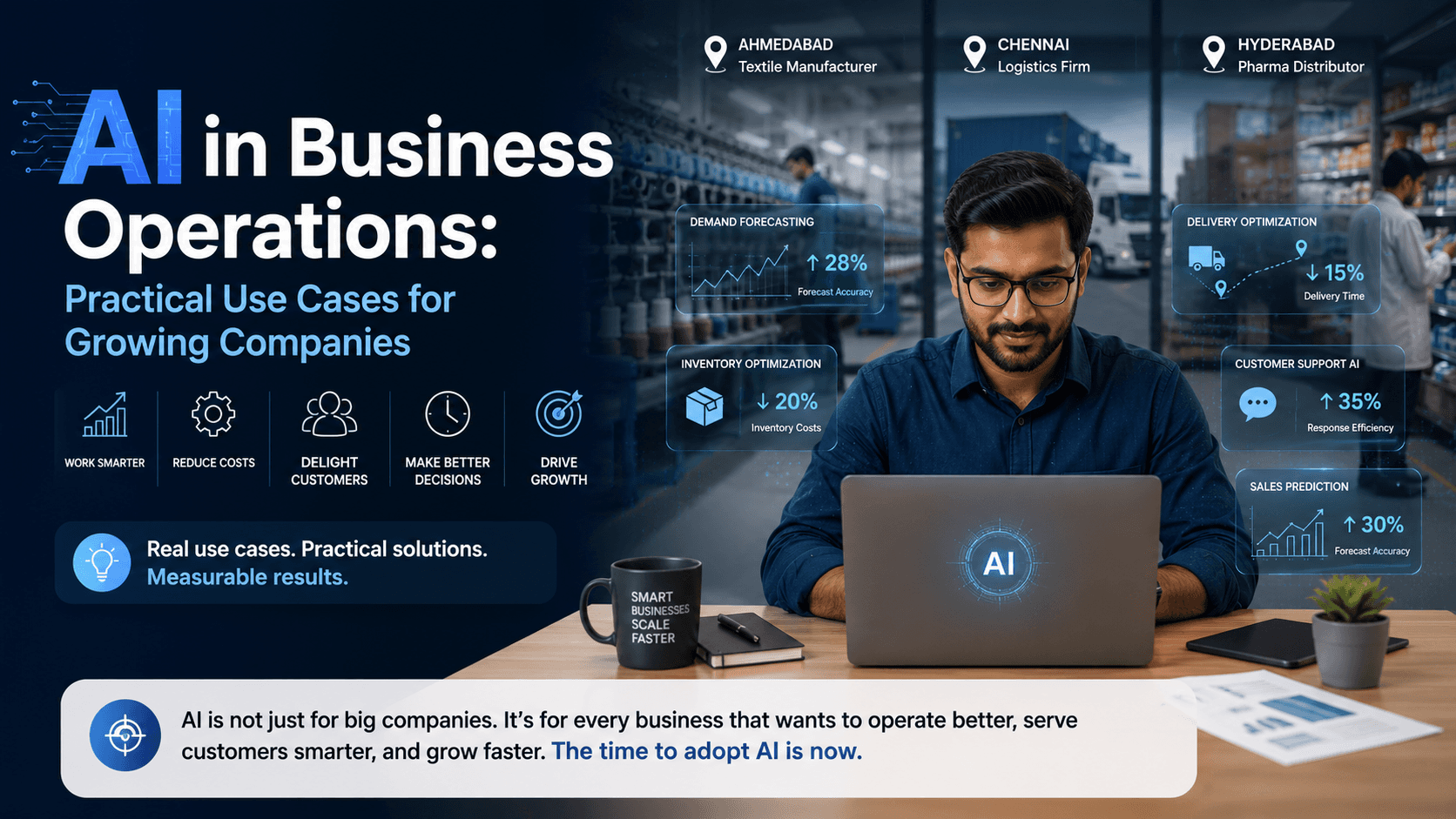
A textile manufacturer in Ahmedabad can use AI-powered quality inspection systems to reduce defects on the production line. A logistics company in Chennai can optimize delivery routes using predictive analytics and intelligent fleet tracking. A pharma distributor in Hyderabad can automate inventory forecasting and compliance workflows using AI integrated with ERP systems.
The biggest misconception about AI is that businesses need huge budgets or large data science teams to implement it. In reality, most SMEs begin with simple AI workflow automation integrated into their existing ERP or digital systems. Businesses are using AI-powered dashboards, AI chatbots, automated invoice processing, predictive inventory planning, and intelligent reporting without completely transforming their infrastructure.
This guide focuses on practical AI implementation strategies for Indian SMEs. Instead of discussing futuristic concepts, we explore real-world business applications that deliver measurable ROI. Whether you are a founder, CXO, operations leader, or ERP decision-maker, this blog will help you understand where AI fits into your business operations and how to start your AI journey strategically.
Table Of Content
The AI Opportunity for Growing Businesses in India
AI adoption among Indian SMEs is accelerating rapidly because businesses are under increasing pressure to improve efficiency, reduce operational costs, and scale faster. Rising competition, customer expectations, digitization initiatives, and cloud ERP adoption have created the perfect environment for AI-powered operations.
Several government and industry trends are also accelerating AI implementation in India. GST digitisation has increased the availability of structured business data. ERP adoption among SMEs has grown significantly. Affordable cloud-based AI tools have reduced implementation costs. At the same time, initiatives like Make in India and MSME digitization are encouraging businesses to modernize operations.
Businesses that adopt AI are reporting measurable operational improvements:
faster decision-making
lower manual workload
improved reporting accuracy
better customer support responsiveness
Reduced inventory inefficiencies
The businesses gaining the highest ROI are not experimenting with futuristic AI systems. They are implementing practical AI workflows that solve operational problems directly linked to revenue, cost reduction, and scalability.
What Does AI in Business Operations Actually Mean?
AI in business operations refers to using intelligent software systems to automate repetitive tasks, analyze business data, generate insights, and support operational decision-making. AI helps businesses reduce dependency on manual processes while improving accuracy, speed, and scalability.
Unlike traditional automation, AI can learn from data patterns and improve workflows over time. AI systems can identify anomalies, predict outcomes, generate recommendations, and assist teams with operational tasks that normally require significant manual effort.
Businesses commonly use AI in areas like:
invoice processing
demand forecasting
customer support
HR workflows
CRM automation
predictive maintenance
reporting and analytics
The objective is not to replace employees. AI works best when it enhances existing teams by handling repetitive, data-heavy, and operationally intensive activities so employees can focus on strategic and customer-facing work.
Why AI Adoption Is Growing Fast in India
Indian businesses are adopting AI faster than ever because operational complexity is increasing across industries. Companies must handle larger transaction volumes, rising customer expectations, tighter margins, and increasing compliance requirements while still maintaining efficiency.
Cloud infrastructure and SaaS platforms have made AI significantly more accessible for SMEs. Businesses no longer need expensive on-premise infrastructure to implement intelligent workflows. AI-powered ERP systems, analytics tools, automation platforms, and customer support systems are now available through affordable subscription models.
The Indian startup ecosystem has also accelerated awareness around automation and operational technology. Businesses are seeing competitors adopt AI-driven workflows and improve speed, visibility, and customer experience. As a result, operational AI is becoming a competitive necessity rather than an optional innovation project.
Key growth drivers include:
GST and compliance digitisation
ERP adoption growth
affordable AI software
cloud infrastructure availability
manufacturing modernization
rising operational data volumes
Three Core Types of AI Used in Business Operations
1. Automation AI
Automation AI handles repetitive operational workflows using predefined rules and intelligent triggers. It reduces manual effort and ensures tasks are completed consistently and accurately across departments.
Common Use Cases
invoice reminders
workflow approvals
payroll automation
CRM follow-ups
procurement workflows
Business Benefits
lower operational workload
reduced manual errors
faster process execution
improved workflow consistency
2. Predictive AI
Predictive AI analyzes historical business data to forecast future outcomes and operational trends. It helps businesses make proactive decisions instead of reacting after problems occur.
Common Use Cases
demand forecasting
sales forecasting
machine maintenance prediction
customer churn analysis
inventory optimization
Business Benefits
better planning accuracy
lower stockouts
reduced downtime
improved forecasting visibility
3. Generative AI
Generative AI creates responses, summaries, recommendations, and business content using contextual data. It is commonly used in customer support, reporting, sales, and communication workflows.
Common Use Cases
AI chatbots
email drafting
report generation
support summaries
AI-powered FAQs
Business Benefits
faster communication
improved response speed
scalable support operations
reduced repetitive writing work
Why AI Works Best With ERP Systems
AI performs best when connected to structured operational data. ERP systems act as the central data foundation that allows AI systems to access accurate and real-time business information across departments.
Without ERP systems, data is often fragmented across Excel files, emails, WhatsApp messages, and disconnected software tools. This reduces AI accuracy and limits automation capabilities. ERP systems centralize finance, inventory, procurement, HR, sales, and manufacturing data into a single operational platform.
When AI integrates with ERP systems:
workflows become intelligent
reporting becomes real-time
forecasting becomes more accurate
automation becomes scalable
ERP platforms like ERPNext and Odoo are especially effective for SMEs because they support workflow automation, analytics integration, and custom AI modules without requiring enterprise-level budgets.
AI Use Cases Across Business Functions
AI in Finance & Accounts
Finance departments spend large amounts of time on invoice matching, reconciliation, reporting, and compliance tasks. AI helps automate these workflows while improving accuracy and reducing delays.
Practical Use Cases
invoice OCR processing
AI-powered reconciliation
GST workflow automation
payment anomaly detection
cash flow forecasting
Business Benefits
faster financial closing
reduced accounting errors
lower manual effort
better financial visibility
AI in Sales & CRM
Sales teams often lose productivity because of manual CRM updates and inconsistent follow-up processes. AI helps improve lead prioritization and customer engagement.
Practical Use Cases
AI lead scoring
intelligent follow-up workflows
sales forecasting
customer churn prediction
AI-generated summaries
Business Benefits
higher conversion rates
faster lead response
improved customer retention
better pipeline visibility
AI in Inventory & Supply Chain
Inventory optimization is one of the highest-ROI AI applications for SMEs. AI helps businesses balance stock availability while reducing excess inventory carrying costs.
Practical Use Cases
demand forecasting
smart reorder alerts
supplier analytics
route optimization
warehouse planning
Business Benefits
lower stockouts
improved inventory planning
reduced wastage
faster procurement decisions
AI in Human Resources
HR teams handle hiring, onboarding, payroll, compliance, and employee management simultaneously. AI reduces administrative workload and improves operational efficiency.
Practical Use Cases
resume screening
onboarding chatbots
attendance anomaly detection
payroll workflow automation
attrition prediction
Business Benefits
reduced HR workload
faster recruitment
improved compliance accuracy
better employee management
AI in Customer Support
Customer expectations for response speed and availability continue to rise. AI-powered support systems help businesses scale customer service without increasing operational costs significantly.
Practical Use Cases
AI chatbots
ticket routing
sentiment analysis
automated FAQs
AI support summaries
Business Benefits
faster customer response
lower support costs
improved customer experience
scalable support operations
AI in Manufacturing Operations
Manufacturing businesses use AI to reduce downtime, improve production quality, and optimize operational planning. AI-driven manufacturing systems improve both efficiency and compliance.
Practical Use Cases
predictive maintenance
visual quality inspection
production scheduling
machine analytics
energy optimization
Business Benefits
reduced downtime
improved product quality
lower maintenance costs
higher operational efficiency
AI vs Traditional Automation
Traditional automation follows fixed rules and can only execute predefined workflows. AI automation is adaptive and learns from operational data patterns over time.
Traditional Automation
rule-based workflows
static execution
predictable tasks
no learning capability
AI Automation
data-driven decisions
predictive capabilities
adaptive workflows
continuous optimization
AI enables businesses to automate more complex and variable operational scenarios compared to traditional workflow automation tools.
AI ROI Metrics
Businesses implementing operational AI commonly experience measurable improvements across productivity, reporting, and customer service KPIs.
Typical Improvements
invoice processing time ↓ 60%
customer response time ↓ 70%
inventory stockouts ↓ 40%
HR screening workload ↓ 80%
manual reporting work ↓ 65%
operational downtime ↓ 45%
The strongest ROI usually comes from reducing repetitive operational workload and improving decision-making speed.
AI Readiness Assessment
Not every business is immediately ready for AI implementation. Businesses should first assess whether their operational foundation and data systems are mature enough to support AI workflows.
Questions to Evaluate
Do you have structured operational data?
Are business processes digitized?
Is your ERP actively used across departments?
Are repetitive tasks consuming operational time?
Is leadership supportive of automation?
If the answer to most of these is “No,” the first step should be ERP implementation or workflow digitisation before advanced AI adoption.
AI Maturity Model for SMEs
Businesses usually adopt AI gradually through different stages of operational maturity rather than implementing advanced AI systems immediately.
Stage 1 — Manual Operations
Businesses rely heavily on Excel sheets, emails, and disconnected workflows.
Stage 2 — ERP Digitisation
Core operations become centralized within ERP systems.
Stage 3 — Workflow Automation
Routine workflows become automated through integrations and business rules.
Stage 4 — AI-Assisted Operations
Businesses begin using AI forecasting, analytics, and intelligent automation.
Stage 5 — Predictive Operations
Advanced AI systems support predictive planning and autonomous operational intelligence.
Best AI Projects to Start With
SMEs should start with low-complexity, high-ROI AI projects that deliver measurable operational improvements quickly.
Recommended Starting Points
AI invoice reminders
AI chatbot deployment
OCR invoice processing
lead scoring
AI dashboards
demand forecasting
These projects typically have:
faster implementation
lower operational risk
measurable ROI
easier employee adoption
Common AI Implementation Mistakes
Many businesses fail with AI because they focus on tools before fixing operational workflows and data quality.
Common Mistakes
poor data quality
automating broken processes
unrealistic expectations
lack of employee adoption
disconnected systems
no ERP foundation
Successful AI implementation requires:
clear operational objectives
phased rollout strategies
measurable KPIs
structured business data
What AI Cannot Replace in Business
AI is extremely effective for operational automation and data analysis, but it cannot replace several critical human capabilities inside organizations.
AI Cannot Replace
leadership
negotiation
creativity
strategic thinking
relationship management
organizational culture
human judgment
The best businesses use AI to enhance employee productivity rather than replace teams entirely.
AI Tool Ecosystem Commonly Used by SMEs
Businesses often combine ERP systems, automation platforms, analytics tools, and AI APIs to build scalable operational AI workflows.
Common AI Tools
ERPNext
Odoo
Zapier
Make
OpenAI APIs
Power BI
Metabase
Freshdesk AI
Intercom AI
The ideal technology stack depends on operational complexity, industry, and business goals.
Conclusion
AI in business operations is no longer experimental or limited to large enterprises. Indian SMEs are actively using AI to automate workflows, improve operational visibility, reduce manual effort, and scale more efficiently.
The businesses seeing the highest ROI are not chasing futuristic AI concepts. They are implementing practical AI workflows connected to ERP systems, operational data, and measurable business outcomes.
At Ambibuzz Technologies, we help Indian businesses implement:
AI-powered ERP workflows
AI automation
predictive analytics
intelligent dashboards
AI customer support systems
operational AI integrations
using ERPNext, Odoo, custom automation frameworks, and scalable business systems.
Businesses that start small, implement strategically, and scale gradually will gain a major operational advantage in the coming years.
Visit www.ambibuzz.com to explore how AI can improve your business operations.
The AI Opportunity for Growing Businesses in India
AI adoption among Indian SMEs is accelerating rapidly because businesses are under increasing pressure to improve efficiency, reduce operational costs, and scale faster. Rising competition, customer expectations, digitization initiatives, and cloud ERP adoption have created the perfect environment for AI-powered operations.
Several government and industry trends are also accelerating AI implementation in India. GST digitisation has increased the availability of structured business data. ERP adoption among SMEs has grown significantly. Affordable cloud-based AI tools have reduced implementation costs. At the same time, initiatives like Make in India and MSME digitization are encouraging businesses to modernize operations.
Businesses that adopt AI are reporting measurable operational improvements:
faster decision-making
lower manual workload
improved reporting accuracy
better customer support responsiveness
Reduced inventory inefficiencies
The businesses gaining the highest ROI are not experimenting with futuristic AI systems. They are implementing practical AI workflows that solve operational problems directly linked to revenue, cost reduction, and scalability.
What Does AI in Business Operations Actually Mean?
AI in business operations refers to using intelligent software systems to automate repetitive tasks, analyze business data, generate insights, and support operational decision-making. AI helps businesses reduce dependency on manual processes while improving accuracy, speed, and scalability.
Unlike traditional automation, AI can learn from data patterns and improve workflows over time. AI systems can identify anomalies, predict outcomes, generate recommendations, and assist teams with operational tasks that normally require significant manual effort.
Businesses commonly use AI in areas like:
invoice processing
demand forecasting
customer support
HR workflows
CRM automation
predictive maintenance
reporting and analytics
The objective is not to replace employees. AI works best when it enhances existing teams by handling repetitive, data-heavy, and operationally intensive activities so employees can focus on strategic and customer-facing work.
Why AI Adoption Is Growing Fast in India
Indian businesses are adopting AI faster than ever because operational complexity is increasing across industries. Companies must handle larger transaction volumes, rising customer expectations, tighter margins, and increasing compliance requirements while still maintaining efficiency.
Cloud infrastructure and SaaS platforms have made AI significantly more accessible for SMEs. Businesses no longer need expensive on-premise infrastructure to implement intelligent workflows. AI-powered ERP systems, analytics tools, automation platforms, and customer support systems are now available through affordable subscription models.
The Indian startup ecosystem has also accelerated awareness around automation and operational technology. Businesses are seeing competitors adopt AI-driven workflows and improve speed, visibility, and customer experience. As a result, operational AI is becoming a competitive necessity rather than an optional innovation project.
Key growth drivers include:
GST and compliance digitisation
ERP adoption growth
affordable AI software
cloud infrastructure availability
manufacturing modernization
rising operational data volumes
Three Core Types of AI Used in Business Operations
1. Automation AI
Automation AI handles repetitive operational workflows using predefined rules and intelligent triggers. It reduces manual effort and ensures tasks are completed consistently and accurately across departments.
Common Use Cases
invoice reminders
workflow approvals
payroll automation
CRM follow-ups
procurement workflows
Business Benefits
lower operational workload
reduced manual errors
faster process execution
improved workflow consistency
2. Predictive AI
Predictive AI analyzes historical business data to forecast future outcomes and operational trends. It helps businesses make proactive decisions instead of reacting after problems occur.
Common Use Cases
demand forecasting
sales forecasting
machine maintenance prediction
customer churn analysis
inventory optimization
Business Benefits
better planning accuracy
lower stockouts
reduced downtime
improved forecasting visibility
3. Generative AI
Generative AI creates responses, summaries, recommendations, and business content using contextual data. It is commonly used in customer support, reporting, sales, and communication workflows.
Common Use Cases
AI chatbots
email drafting
report generation
support summaries
AI-powered FAQs
Business Benefits
faster communication
improved response speed
scalable support operations
reduced repetitive writing work
Why AI Works Best With ERP Systems
AI performs best when connected to structured operational data. ERP systems act as the central data foundation that allows AI systems to access accurate and real-time business information across departments.
Without ERP systems, data is often fragmented across Excel files, emails, WhatsApp messages, and disconnected software tools. This reduces AI accuracy and limits automation capabilities. ERP systems centralize finance, inventory, procurement, HR, sales, and manufacturing data into a single operational platform.
When AI integrates with ERP systems:
workflows become intelligent
reporting becomes real-time
forecasting becomes more accurate
automation becomes scalable
ERP platforms like ERPNext and Odoo are especially effective for SMEs because they support workflow automation, analytics integration, and custom AI modules without requiring enterprise-level budgets.
AI Use Cases Across Business Functions
AI in Finance & Accounts
Finance departments spend large amounts of time on invoice matching, reconciliation, reporting, and compliance tasks. AI helps automate these workflows while improving accuracy and reducing delays.
Practical Use Cases
invoice OCR processing
AI-powered reconciliation
GST workflow automation
payment anomaly detection
cash flow forecasting
Business Benefits
faster financial closing
reduced accounting errors
lower manual effort
better financial visibility
AI in Sales & CRM
Sales teams often lose productivity because of manual CRM updates and inconsistent follow-up processes. AI helps improve lead prioritization and customer engagement.
Practical Use Cases
AI lead scoring
intelligent follow-up workflows
sales forecasting
customer churn prediction
AI-generated summaries
Business Benefits
higher conversion rates
faster lead response
improved customer retention
better pipeline visibility
AI in Inventory & Supply Chain
Inventory optimization is one of the highest-ROI AI applications for SMEs. AI helps businesses balance stock availability while reducing excess inventory carrying costs.
Practical Use Cases
demand forecasting
smart reorder alerts
supplier analytics
route optimization
warehouse planning
Business Benefits
lower stockouts
improved inventory planning
reduced wastage
faster procurement decisions
AI in Human Resources
HR teams handle hiring, onboarding, payroll, compliance, and employee management simultaneously. AI reduces administrative workload and improves operational efficiency.
Practical Use Cases
resume screening
onboarding chatbots
attendance anomaly detection
payroll workflow automation
attrition prediction
Business Benefits
reduced HR workload
faster recruitment
improved compliance accuracy
better employee management
AI in Customer Support
Customer expectations for response speed and availability continue to rise. AI-powered support systems help businesses scale customer service without increasing operational costs significantly.
Practical Use Cases
AI chatbots
ticket routing
sentiment analysis
automated FAQs
AI support summaries
Business Benefits
faster customer response
lower support costs
improved customer experience
scalable support operations
AI in Manufacturing Operations
Manufacturing businesses use AI to reduce downtime, improve production quality, and optimize operational planning. AI-driven manufacturing systems improve both efficiency and compliance.
Practical Use Cases
predictive maintenance
visual quality inspection
production scheduling
machine analytics
energy optimization
Business Benefits
reduced downtime
improved product quality
lower maintenance costs
higher operational efficiency
AI vs Traditional Automation
Traditional automation follows fixed rules and can only execute predefined workflows. AI automation is adaptive and learns from operational data patterns over time.
Traditional Automation
rule-based workflows
static execution
predictable tasks
no learning capability
AI Automation
data-driven decisions
predictive capabilities
adaptive workflows
continuous optimization
AI enables businesses to automate more complex and variable operational scenarios compared to traditional workflow automation tools.
AI ROI Metrics
Businesses implementing operational AI commonly experience measurable improvements across productivity, reporting, and customer service KPIs.
Typical Improvements
invoice processing time ↓ 60%
customer response time ↓ 70%
inventory stockouts ↓ 40%
HR screening workload ↓ 80%
manual reporting work ↓ 65%
operational downtime ↓ 45%
The strongest ROI usually comes from reducing repetitive operational workload and improving decision-making speed.
AI Readiness Assessment
Not every business is immediately ready for AI implementation. Businesses should first assess whether their operational foundation and data systems are mature enough to support AI workflows.
Questions to Evaluate
Do you have structured operational data?
Are business processes digitized?
Is your ERP actively used across departments?
Are repetitive tasks consuming operational time?
Is leadership supportive of automation?
If the answer to most of these is “No,” the first step should be ERP implementation or workflow digitisation before advanced AI adoption.
AI Maturity Model for SMEs
Businesses usually adopt AI gradually through different stages of operational maturity rather than implementing advanced AI systems immediately.
Stage 1 — Manual Operations
Businesses rely heavily on Excel sheets, emails, and disconnected workflows.
Stage 2 — ERP Digitisation
Core operations become centralized within ERP systems.
Stage 3 — Workflow Automation
Routine workflows become automated through integrations and business rules.
Stage 4 — AI-Assisted Operations
Businesses begin using AI forecasting, analytics, and intelligent automation.
Stage 5 — Predictive Operations
Advanced AI systems support predictive planning and autonomous operational intelligence.
Best AI Projects to Start With
SMEs should start with low-complexity, high-ROI AI projects that deliver measurable operational improvements quickly.
Recommended Starting Points
AI invoice reminders
AI chatbot deployment
OCR invoice processing
lead scoring
AI dashboards
demand forecasting
These projects typically have:
faster implementation
lower operational risk
measurable ROI
easier employee adoption
Common AI Implementation Mistakes
Many businesses fail with AI because they focus on tools before fixing operational workflows and data quality.
Common Mistakes
poor data quality
automating broken processes
unrealistic expectations
lack of employee adoption
disconnected systems
no ERP foundation
Successful AI implementation requires:
clear operational objectives
phased rollout strategies
measurable KPIs
structured business data
What AI Cannot Replace in Business
AI is extremely effective for operational automation and data analysis, but it cannot replace several critical human capabilities inside organizations.
AI Cannot Replace
leadership
negotiation
creativity
strategic thinking
relationship management
organizational culture
human judgment
The best businesses use AI to enhance employee productivity rather than replace teams entirely.
AI Tool Ecosystem Commonly Used by SMEs
Businesses often combine ERP systems, automation platforms, analytics tools, and AI APIs to build scalable operational AI workflows.
Common AI Tools
ERPNext
Odoo
Zapier
Make
OpenAI APIs
Power BI
Metabase
Freshdesk AI
Intercom AI
The ideal technology stack depends on operational complexity, industry, and business goals.
Conclusion
AI in business operations is no longer experimental or limited to large enterprises. Indian SMEs are actively using AI to automate workflows, improve operational visibility, reduce manual effort, and scale more efficiently.
The businesses seeing the highest ROI are not chasing futuristic AI concepts. They are implementing practical AI workflows connected to ERP systems, operational data, and measurable business outcomes.
At Ambibuzz Technologies, we help Indian businesses implement:
AI-powered ERP workflows
AI automation
predictive analytics
intelligent dashboards
AI customer support systems
operational AI integrations
using ERPNext, Odoo, custom automation frameworks, and scalable business systems.
Businesses that start small, implement strategically, and scale gradually will gain a major operational advantage in the coming years.
Visit www.ambibuzz.com to explore how AI can improve your business operations.
Table Of Content
Table Of Content
Popular Tags