ERP for Startups vs Enterprises: What Changes?
|
Nidhi Goda
Introduction
Not every business needs the same ERP. A system that works beautifully for a fast-moving 20-person startup can quickly become a burden for a 2,000-person organisation. And on the flip side, an enterprise-grade ERP is often way more than a growing company actually needs. They stage your business in the shapes of everything, what you need, how much you should spend, and how complex your system should be.
Table Of Content
Startups and enterprises are chasing very different things. A startup is trying to move fast, make quick decisions, and keep costs in check.
An enterprise is focused on control, consistency, and compliance across teams, departments, and locations. Because the goals are so different, naturally, the ERP expectations are too.
2. What Startups actually need
At the early stage, the goal is not to build the perfect system. It is to build a structure. You want to stop running things on spreadsheets, cut down on errors, and make faster decisions without spending months on a big implementation or a large upfront budget.
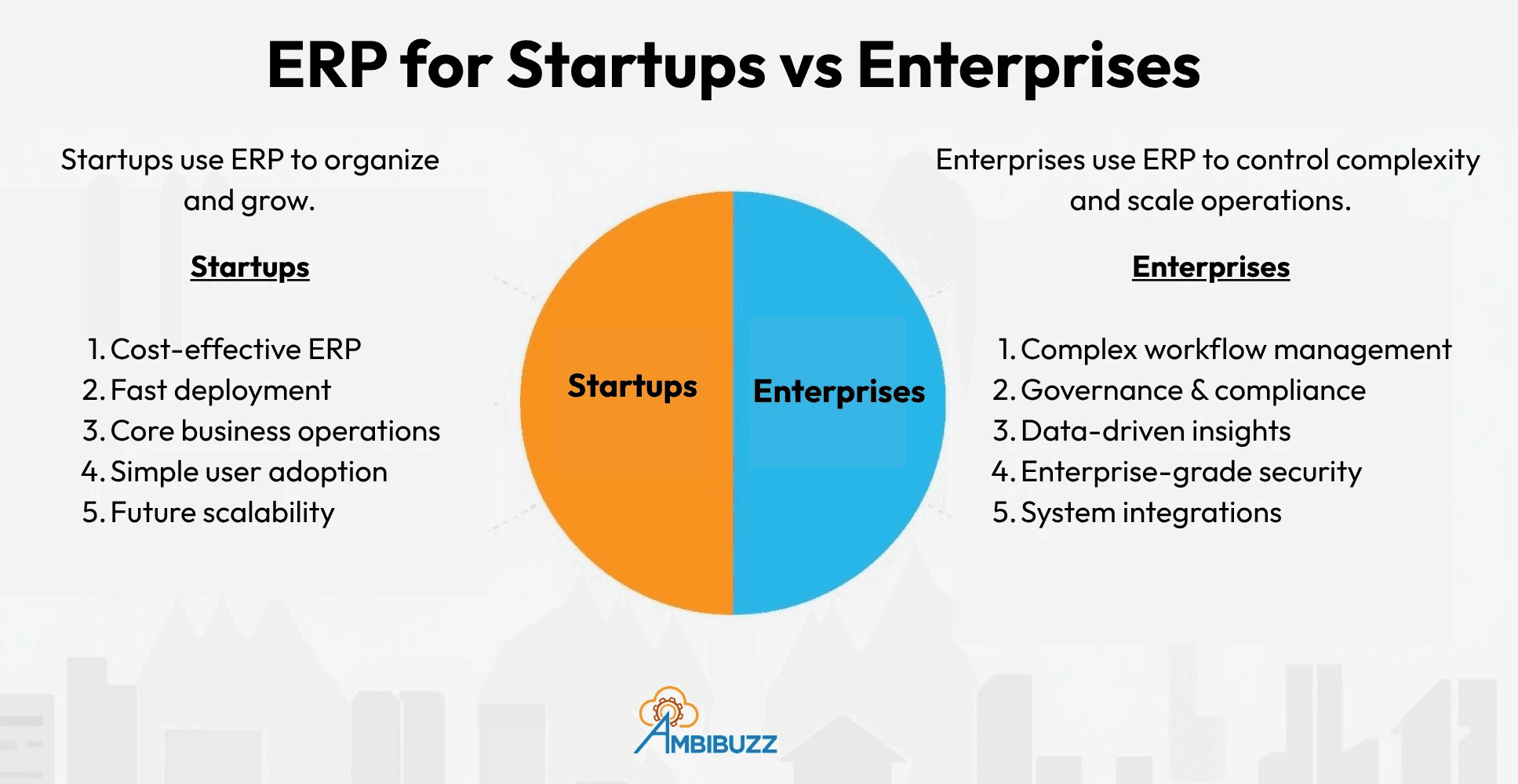
Startup priorities | Enterprise priorities |
|
|
3. What Enterprises need
At scale, complexity is just part of life. Large teams, multiple locations, intricate supply chains, and regulatory requirements mean your ERP needs to do a lot more than track expenses. Enterprises need reliability, visibility, and governance built into every workflow.
Unlike startups, enterprises are also more willing to make a bigger investment in licensing, implementation, and training. And that makes sense, because the cost of a system failure at that scale is simply much higher.
4. Customisation, Cost, and Team Size
Startups tend to avoid customisations to keep things lean and move quickly. A default purchase workflow gets the job done. Enterprises, though, often need custom approval flows that loop in finance, legal, and procurement teams. That is a fair requirement when you are operating at that size.
Team size also affects how people actually adopt the system. A small team can get up and running with minimal hand-holding. Larger organisations need structured onboarding, role-based access, and well-documented processes so the system gets used consistently across the board.
A simple way to think about it: the right ERP matches where your business is today, not just where you hope to be in five years.
5. Scalability: The one thing both stages share
Whether you are a startup or a large enterprise, growth is the goal. A good ERP for a startup should let you grow without having to tear everything down and start again. A good ERP for an enterprise should handle that growth without slowing down.
Scalability across users, transactions, locations, and integrations should never be an afterthought when you are picking a system.
6. Choosing the Right ERP for your stage
If you are a startup, look for something affordable, fast to set up, and easy for a small team to use without much training. Make sure it can grow with you. If you are an enterprise, you need a system built for scale: one that supports advanced planning, compliance, large teams, and plays well with the tools you already have.
Getting this right reduces a lot of operational headaches. Getting it wrong creates friction, drives up costs, and slows your team down when they should be focused on building the business.
At Ambibuzz, we work with both startups and enterprises, and we tailor the ERP approach based on where you actually are in your journey. For early-stage companies, we focus on getting you set up quickly with the essentials and making sure the team feels comfortable using it from day one.
For larger organisations, we go deeper into process mapping, multi-department workflows, compliance requirements, and connecting everything together.
The goal is always the same: The right system for where you are now and where you are headed.
Both startups and enterprises benefit from having a good ERP in place. But what "good" looks like is very different depending on your stage. Understanding that difference is really the first step to making a smart choice.
Startups and enterprises are chasing very different things. A startup is trying to move fast, make quick decisions, and keep costs in check.
An enterprise is focused on control, consistency, and compliance across teams, departments, and locations. Because the goals are so different, naturally, the ERP expectations are too.
2. What Startups actually need
At the early stage, the goal is not to build the perfect system. It is to build a structure. You want to stop running things on spreadsheets, cut down on errors, and make faster decisions without spending months on a big implementation or a large upfront budget.
Startup priorities | Enterprise priorities |
|
|
3. What Enterprises need
At scale, complexity is just part of life. Large teams, multiple locations, intricate supply chains, and regulatory requirements mean your ERP needs to do a lot more than track expenses. Enterprises need reliability, visibility, and governance built into every workflow.
Unlike startups, enterprises are also more willing to make a bigger investment in licensing, implementation, and training. And that makes sense, because the cost of a system failure at that scale is simply much higher.
4. Customisation, Cost, and Team Size
Startups tend to avoid customisations to keep things lean and move quickly. A default purchase workflow gets the job done. Enterprises, though, often need custom approval flows that loop in finance, legal, and procurement teams. That is a fair requirement when you are operating at that size.
Team size also affects how people actually adopt the system. A small team can get up and running with minimal hand-holding. Larger organisations need structured onboarding, role-based access, and well-documented processes so the system gets used consistently across the board.
A simple way to think about it: the right ERP matches where your business is today, not just where you hope to be in five years.
5. Scalability: The one thing both stages share
Whether you are a startup or a large enterprise, growth is the goal. A good ERP for a startup should let you grow without having to tear everything down and start again. A good ERP for an enterprise should handle that growth without slowing down.
Scalability across users, transactions, locations, and integrations should never be an afterthought when you are picking a system.
6. Choosing the Right ERP for your stage
If you are a startup, look for something affordable, fast to set up, and easy for a small team to use without much training. Make sure it can grow with you. If you are an enterprise, you need a system built for scale: one that supports advanced planning, compliance, large teams, and plays well with the tools you already have.
Getting this right reduces a lot of operational headaches. Getting it wrong creates friction, drives up costs, and slows your team down when they should be focused on building the business.
At Ambibuzz, we work with both startups and enterprises, and we tailor the ERP approach based on where you actually are in your journey. For early-stage companies, we focus on getting you set up quickly with the essentials and making sure the team feels comfortable using it from day one.
For larger organisations, we go deeper into process mapping, multi-department workflows, compliance requirements, and connecting everything together.
The goal is always the same: The right system for where you are now and where you are headed.
Both startups and enterprises benefit from having a good ERP in place. But what "good" looks like is very different depending on your stage. Understanding that difference is really the first step to making a smart choice.
Table Of Content
Table Of Content
Popular Tags