Signs Your Business Has Outgrown Manual Processes
|
Ambibuzz Team
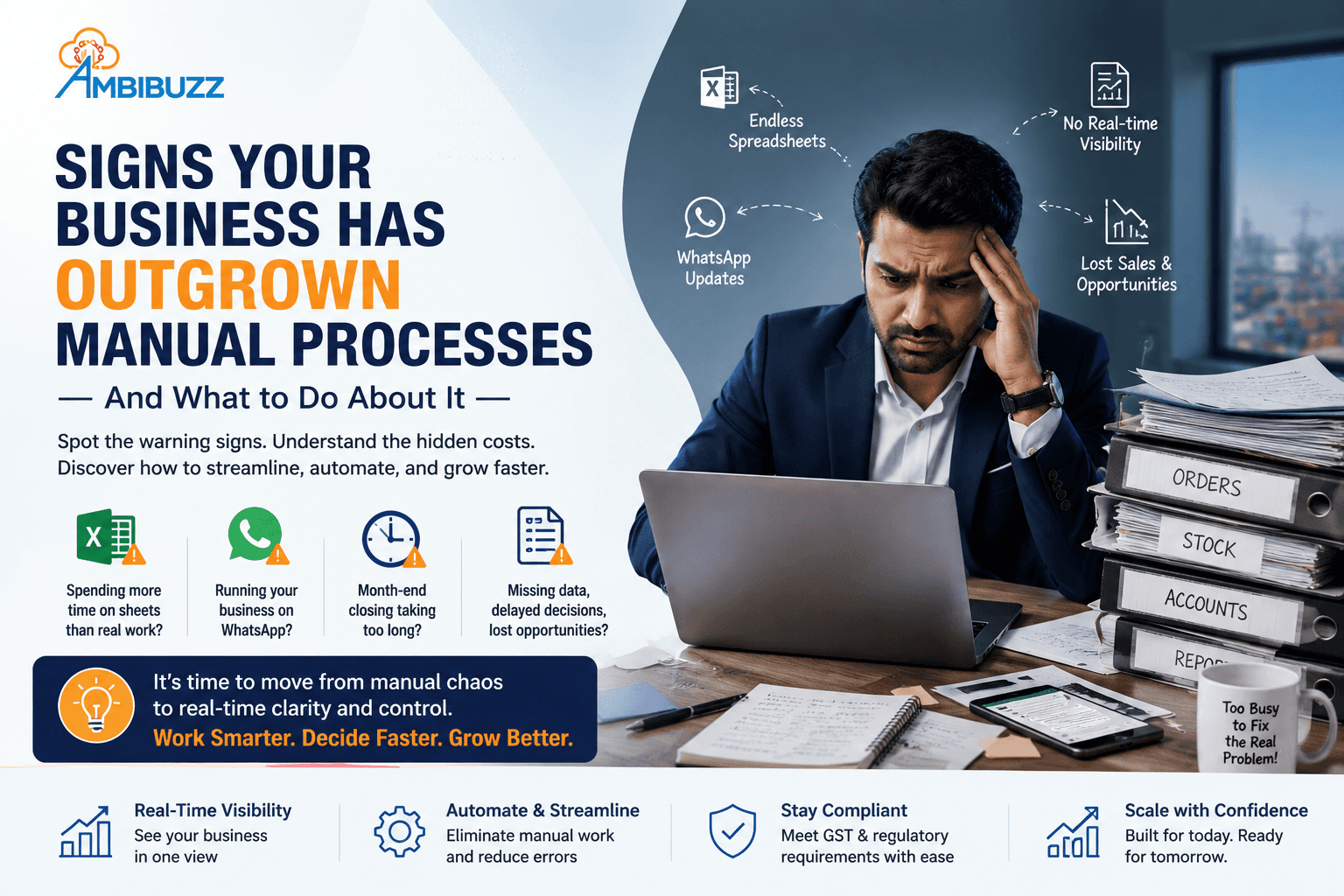
Introduction
Every business starts the same way.
A notebook here. An Excel sheet there. A WhatsApp group to coordinate orders. A phone call to check if the stock arrived.
It works in the early days. It gets the job done when you have 5 people and 50 transactions a month.
But then your business grows. Orders double. The team expands. New cities. New products. New compliance requirements.
And suddenly, the same tools that helped you start are now slowing you down.
This is the moment most Indian business owners dread - but many fail to recognise in time.
In this blog, we share the clearest signs that your business has outgrown manual processes - and exactly what you should do next.
Table Of Content
10 Clear Signs Your Business Has Outgrown Manual Processes
Manual vs Digital: What Changes When You Make the Switch
Why Excel and WhatsApp Are Not Business Systems
How to Move Away From Manual Processes: A Practical Roadmap
Which Indian Businesses Are Making This Transition Right Now?
Conclusion: The Best Time to Act Was Yesterday. The Second Best Is Today.
Key Takeaways
What This Blog Will Help You Understand
|
The Real Cost of Staying Manual
Before we look at the warning signs, let us understand the scale of the problem.
30% of business revenue is lost to inefficiencies caused by manual processes (McKinsey) | 40 hrs wasted per employee every month on repetitive manual tasks in SMEs | 2–3x faster growth seen by businesses that digitise operations before competitors |
These are not small numbers. For a business doing INR 5 crore a year, a 30% inefficiency means INR 1.5 crore in leakage. That is money you are leaving on the table every single year.
Now let us look at the signs that this is already happening in your business.
10 Clear Signs Your Business Has Outgrown Manual Processes
1 | Your Team Spends More Time Updating Sheets Than Doing Actual Work If your sales team is copying data from one Excel file into another, your accounts team is manually typing invoices, or your operations manager is texting suppliers for stock updates - you have a serious efficiency problem. Manual data entry is not just slow. It is error-prone. A single wrong entry in a pricing sheet can cost you thousands. Business Impact: Team productivity drops by up to 40% when manual data entry consumes working hours. |
2 | You Cannot Tell What Your Business Looks Like Right Now Can you tell - right now, at this moment - how much stock you have, which invoices are overdue, or which salesperson is closest to their target? If the answer is 'I need to check with someone' or 'I'll know by Monday' - your business is flying blind. Real-time visibility is not a luxury. It is a survival tool. Business Impact: Delayed decision-making costs growing businesses 15–20% in missed opportunities monthly. |
3 | Errors and Mistakes Are Becoming Normal Duplicate orders. Wrong shipments. Incorrect invoices. Missed GST entries. When errors become routine, teams normalise them. They start spending more time fixing mistakes than preventing them. This is a classic sign of a system that has hit its limit. Business Impact: Human error in manual systems costs Indian SMEs an estimated INR 80,000 to 3,00,000 per year in rework and corrections. |
4 | Your Month-End Close Takes More Than 5 Days If closing your monthly accounts takes a week or more, it is a sign that your finance team is manually reconciling data from multiple disconnected sources. Modern businesses running on ERP can close books in 1 to 2 days. If yours takes longer, you are working harder than you need to. Business Impact: Slow month-end close means leadership makes decisions on outdated financial data every single month. |
5 | You Have Lost Sales Because of Poor Visibility Promised delivery dates missed because stock was not tracked. A hot lead gone cold because no one followed up on time. A repeat order lost because the sales team did not know the customer's last purchase history. These are not sales team failures. These are system failures. Manual processes cannot support the speed of modern business. Business Impact: Indian businesses lose 10–15% of potential revenue annually due to poor operational visibility. |
6 | New Employees Take Too Long to Get Productive When processes live in people's heads or in personal Excel files, every new hire starts from scratch. There is no standard workflow. No centralised reference. No process documentation. Onboarding becomes a months-long struggle. And when experienced employees leave, they take institutional knowledge with them. Business Impact: Businesses without standardised digital processes lose 20–30% of operational knowledge when key employees exit. |
7 | Your Compliance and Tax Filing Is Always Stressful GST returns. TDS calculations. PF and ESI compliance. Labour law requirements. If your finance team dreads month-end because compliance data is scattered across spreadsheets and paper records, your business is carrying unnecessary risk. One wrong GST filing can trigger audits and penalties. Business Impact: Manual compliance management increases the risk of penalty notices and regulatory issues by 3x. |
8 | Coordination Between Departments Happens on WhatsApp The purchase team sends POs on WhatsApp. The warehouse confirms dispatch over a call. The accounts team gets a photo of an invoice. This is not a workflow. This is organised chaos. And it works - until it does not. Messages get missed. Approvals get skipped. Audits become nightmares. Business Impact: Informal communication chains cause an average of 3 to 5 process breakdowns per week in fast-growing SMEs. |
9 | Scaling Up Feels Impossible Without Hiring More People If your only answer to increased business volume is 'hire more staff to manage it', your processes are the bottleneck - not your team. Well-digitised businesses can scale revenue by 2x without proportionally scaling headcount. Manual businesses cannot achieve this. Every 10% growth requires 10% more manual effort. Business Impact: Businesses stuck in manual operations spend 35–50% more on administrative headcount than digitised peers. |
10 | You Are Starting to Lose to Smaller, More Agile Competitors Perhaps the most painful sign of all. A younger, leaner competitor with the same product or service is winning deals you used to close. Why? Because they respond faster. They quote accurately. They deliver on time. They have real-time data. They are operating on a digital backbone while you are still on spreadsheets. Business Impact: Businesses that delay digitisation lose competitive ground within 18–24 months in fast-moving Indian markets. |
Manual vs Digital: What Changes When You Make the Switch
This table shows exactly what your business looks like before and after moving away from manual processes. Use it to identify which gaps apply to your business today.
Business Process | Manual Approach (Old Way) | Digital/ERP Approach (Smart Way) |
|---|---|---|
Inventory tracking | Manual Excel sheets, frequent errors | Auto stock updates, real-time alerts |
Invoice generation | Typed manually, sent via email/WhatsApp | Auto-generated, GST-compliant, e-signed |
Sales reporting | Excel pivot tables, weekly delay | Live dashboards, instant drill-down |
HR attendance | Paper registers or basic biometric | App-based, auto-linked to payroll |
Purchase orders | WhatsApp messages to vendors | Auto PO on reorder trigger, vendor portal |
Customer follow-up | Sticky notes, calendar reminders | CRM auto-sequences, AI scoring |
Financial reconciliation | Manual bank statement matching | AI reconciliation, anomaly alerts |
Decision-making | Gut feeling or delayed reports | Real-time BI dashboards, predictive alerts |
Note: The 'Digital/ERP Approach' column reflects capabilities available through platforms like ERPNext and Odoo, implemented by Ambibuzz for Indian businesses.
Why Excel and WhatsApp Are Not Business Systems
Many business owners push back at this point. They say: 'But Excel works for us. We have been using it for years.'
Here is the truth. Excel is a powerful tool. But it was built for individual analysis - not for running a business with multiple users, real-time transactions, and growing compliance needs.
What Excel Cannot Do
It cannot show two users the same real-time data simultaneously
It cannot prevent a colleague from accidentally overwriting critical formulas
It cannot auto-generate a GST-compliant invoice and send it to a customer
It cannot alert you when stock hits a reorder point
It cannot link your sales order to your purchase order to your delivery to your invoice
It cannot show you a live dashboard of your business performance
The WhatsApp Problem: WhatsApp is a brilliant communication tool. But it is not an approval workflow, a purchase order system, or a delivery tracking platform. When businesses rely on WhatsApp for operations, there is no audit trail, no accountability, and no system of record. |
The Hidden Costs of Staying Manual
Most business owners think digital transformation is expensive. But they rarely calculate the cost of not transforming.
If 5 employees each waste 2 hours daily on manual tasks at INR 300/hour, that is INR 9,000 per day - or INR 2.7 lakh per month in pure wasted labour.Time cost:
A single wrong shipment, duplicate payment, or GST miscalculation can cost INR 20,000 to 5,00,000 in penalties, returns, or customer compensation.Error cost:
Every hour your sales team spends on data entry is an hour not spent with a customer. Multiply that across 10 reps and 250 working days.Opportunity cost:
Manual processes cap your business at a certain size. Beyond that ceiling, growth becomes painful and expensive. The ceiling arrives faster than most founders expect.Growth cost:
Talented employees do not want to spend their careers copying data between Excel files. High performers leave. Mediocre performers stay. And then the business wonders why productivity is flat.Talent cost:
What Is the Right Solution for Your Pain Point?
Every business pain point caused by manual processes has a specific digital solution. This table maps your problem to the right fix.
Pain Point | Recommended Solution | How It Helps | Tools at Ambibuzz |
|---|---|---|---|
Data scattered everywhere | Cloud ERP | Centralises all data in one system | ERPNext, Odoo |
Slow financial reporting | ERP + BI | Live dashboards, auto-reports | ERPNext + Frappe BI |
High manual workload | Automation (RPA/AI) | Auto-triggers replace repetitive tasks | ERPNext Workflows |
Stockouts or overstock | ERP + AI Forecasting | Demand-based reorder & alerts | ERPNext Inventory |
Poor customer follow-up | CRM Integration | AI lead scoring, auto-follow-up sequences | ERPNext CRM |
Compliance errors (GST/TDS) | ERP Compliance Module | Auto calculations, filing reminders | ERPNext, Odoo |
Slow hiring & onboarding | HRMS + AI Screening | Resume shortlisting, onboarding bots | ERPNext HR |
All solutions in this table are implemented by Ambibuzz using ERPNext, Odoo, and custom automation frameworks - tailored for Indian business requirements.
How to Move Away From Manual Processes: A Practical Roadmap
Making this transition can feel overwhelming. But it does not have to be. Here is a simple, phased approach that works for most Indian businesses.
Audit your current processes.Phase 1 - Map the Pain (Week 1–2):
Write down every process that currently relies on Excel, WhatsApp, or manual effort. Rank them by how much time they consume and how often errors occur.
Choose the right ERP or automation platform.Phase 2 - Choose Your Foundation (Week 2–4):
For most Indian SMEs, ERPNext or Odoo is the right starting point. Both are cost-effective, India-ready with GST compliance, and highly customisable. Talk to a vendor like Ambibuzz who understands your industry.
Start with the highest-pain department.Phase 3 - Go Live in One Area First (Month 1–2):
Do not try to digitise everything at once. Pick the department with the most manual pain - typically finance or inventory - and go live there first. Build confidence. Show early wins to the team.
Expand to other departments gradually.Phase 4 - Roll Out Across the Business (Month 2–6):
Once the first department is running smoothly, expand to sales, HR, procurement, and customer service. Each rollout gets easier because the foundation is already in place.
Layer on BI and automation.Phase 5 - Add Intelligence (Month 4–8):
Once your data is clean and centralised, add Business Intelligence dashboards and automation workflows. This is where the real ROI acceleration happens.
Ambibuzz Approach: We follow this exact 5-phase roadmap with every client. We have seen businesses transform from full manual operations to a digitised ERP environment in as little as 8 weeks. The key is starting - not waiting for the perfect moment. |
Which Indian Businesses Are Making This Transition Right Now?
Here are the types of businesses that typically reach out to us once they recognise these signs.
Manufacturing SMEs in Pune, Ahmedabad, and Coimbatore moving from paper-based production tracking to real-time ERP.
Pharma distributors in Mumbai and Hyderabad replacing manual stock registers with automated inventory management.
Construction companies in Delhi NCR and Bengaluru switching from Excel-based project tracking to ERP with milestone billing.
Trading and import-export firms in Surat and Chennai replacing manual ledgers with cloud-based accounting and GST automation.
Retail chains across Tier 1 and Tier 2 cities moving from WhatsApp-based order management to integrated ERP and POS systems.
Service companies - IT, staffing, logistics - replacing timesheet spreadsheets with automated project and billing management.
If your business falls into any of these categories, the signs in this blog are almost certainly already present. The question is only how long you want to wait.
Frequently Asked Questions
What are manual business processes?
Manual business processes are any operational tasks performed using human effort without software automation - such as recording sales in Excel, sending invoices via email manually, tracking stock in a notebook, or coordinating approvals over WhatsApp.
When should a business switch from Excel to ERP?
The right time to move from Excel to ERP is when your business has more than 10 employees, handles more than 100 transactions per month across departments, or when coordination between teams is creating regular errors or delays. Most Indian SMEs find this threshold arrives between INR 1 crore and INR 5 crore in annual revenue.
What is the cost of ERP implementation in India?
ERP implementation cost in India varies based on the platform and complexity. Cloud ERP subscriptions start at INR 3,000 to INR 25,000 per month. Implementation and customisation fees range from INR 50,000 to several lakhs depending on the number of departments, users, and integrations. Most growing SMEs find full ROI within 6 to 12 months.
Is Cloud ERP better than Excel for a small business?
For a business with more than one department or more than 5 employees dealing with operational data, Cloud ERP is significantly better than Excel. ERP provides real-time multi-user access, automatic data linking across departments, built-in compliance, and error prevention - none of which Excel can offer at scale.
How do I know if my business is ready for digital transformation?
If you answered yes to even 3 of the 10 signs listed in this blog, your business is ready - and likely overdue - for digital transformation. Readiness is not about size. It is about pain. When the pain of staying manual exceeds the perceived effort of changing, you are ready.
What is the difference between digitisation and digital transformation?
Digitisation means converting manual records into digital format - like scanning paper invoices into PDFs. Digital transformation means redesigning how your business operates using technology - like automating the entire invoice-to-payment cycle through ERP. Transformation goes far beyond digitisation.
Can a small business in India afford ERP?
Yes. Modern cloud ERP platforms like ERPNext are open-source, and the cost of implementation has dropped dramatically in the last 5 years. A business with INR 50 lakh to INR 1 crore in annual revenue can get started with ERP for INR 5,000 to INR 15,000 per month - less than the cost of a part-time data entry employee.
What happens if a business waits too long to digitise?
Businesses that delay digitisation face compounding costs: more errors, slower growth, higher operational headcount, and increasing difficulty competing with digitally-native peers. In fast-moving Indian markets, a 12 to 18 month delay can result in meaningful loss of market share - particularly if competitors are already running on ERP and automation.
Conclusion: The Best Time to Act Was Yesterday. The Second Best Is Today.
Every business that is now running smoothly on ERP, automation, and BI once ran on Excel and WhatsApp. The difference between then and now was one decision.
The signs in this blog are not warnings to be afraid of. They are signals to act on.
Your business has clearly grown. Now your systems need to grow with it.
The longer you wait, the more it costs - in time, in money, in talent, and in competitive ground. The best businesses we work with did not wait for the perfect moment. They started with one step.
At Ambibuzz, we help growing Indian businesses make this transition the right way - without disrupting day-to-day operations, without overspending, and with a clear roadmap tailored to your business reality.
You have already recognised the signs. Now let us do something about it.
Key Takeaways
What This Blog Will Help You Understand
|
The Real Cost of Staying Manual
Before we look at the warning signs, let us understand the scale of the problem.
30% of business revenue is lost to inefficiencies caused by manual processes (McKinsey) | 40 hrs wasted per employee every month on repetitive manual tasks in SMEs | 2–3x faster growth seen by businesses that digitise operations before competitors |
These are not small numbers. For a business doing INR 5 crore a year, a 30% inefficiency means INR 1.5 crore in leakage. That is money you are leaving on the table every single year.
Now let us look at the signs that this is already happening in your business.
10 Clear Signs Your Business Has Outgrown Manual Processes
1 | Your Team Spends More Time Updating Sheets Than Doing Actual Work If your sales team is copying data from one Excel file into another, your accounts team is manually typing invoices, or your operations manager is texting suppliers for stock updates - you have a serious efficiency problem. Manual data entry is not just slow. It is error-prone. A single wrong entry in a pricing sheet can cost you thousands. Business Impact: Team productivity drops by up to 40% when manual data entry consumes working hours. |
2 | You Cannot Tell What Your Business Looks Like Right Now Can you tell - right now, at this moment - how much stock you have, which invoices are overdue, or which salesperson is closest to their target? If the answer is 'I need to check with someone' or 'I'll know by Monday' - your business is flying blind. Real-time visibility is not a luxury. It is a survival tool. Business Impact: Delayed decision-making costs growing businesses 15–20% in missed opportunities monthly. |
3 | Errors and Mistakes Are Becoming Normal Duplicate orders. Wrong shipments. Incorrect invoices. Missed GST entries. When errors become routine, teams normalise them. They start spending more time fixing mistakes than preventing them. This is a classic sign of a system that has hit its limit. Business Impact: Human error in manual systems costs Indian SMEs an estimated INR 80,000 to 3,00,000 per year in rework and corrections. |
4 | Your Month-End Close Takes More Than 5 Days If closing your monthly accounts takes a week or more, it is a sign that your finance team is manually reconciling data from multiple disconnected sources. Modern businesses running on ERP can close books in 1 to 2 days. If yours takes longer, you are working harder than you need to. Business Impact: Slow month-end close means leadership makes decisions on outdated financial data every single month. |
5 | You Have Lost Sales Because of Poor Visibility Promised delivery dates missed because stock was not tracked. A hot lead gone cold because no one followed up on time. A repeat order lost because the sales team did not know the customer's last purchase history. These are not sales team failures. These are system failures. Manual processes cannot support the speed of modern business. Business Impact: Indian businesses lose 10–15% of potential revenue annually due to poor operational visibility. |
6 | New Employees Take Too Long to Get Productive When processes live in people's heads or in personal Excel files, every new hire starts from scratch. There is no standard workflow. No centralised reference. No process documentation. Onboarding becomes a months-long struggle. And when experienced employees leave, they take institutional knowledge with them. Business Impact: Businesses without standardised digital processes lose 20–30% of operational knowledge when key employees exit. |
7 | Your Compliance and Tax Filing Is Always Stressful GST returns. TDS calculations. PF and ESI compliance. Labour law requirements. If your finance team dreads month-end because compliance data is scattered across spreadsheets and paper records, your business is carrying unnecessary risk. One wrong GST filing can trigger audits and penalties. Business Impact: Manual compliance management increases the risk of penalty notices and regulatory issues by 3x. |
8 | Coordination Between Departments Happens on WhatsApp The purchase team sends POs on WhatsApp. The warehouse confirms dispatch over a call. The accounts team gets a photo of an invoice. This is not a workflow. This is organised chaos. And it works - until it does not. Messages get missed. Approvals get skipped. Audits become nightmares. Business Impact: Informal communication chains cause an average of 3 to 5 process breakdowns per week in fast-growing SMEs. |
9 | Scaling Up Feels Impossible Without Hiring More People If your only answer to increased business volume is 'hire more staff to manage it', your processes are the bottleneck - not your team. Well-digitised businesses can scale revenue by 2x without proportionally scaling headcount. Manual businesses cannot achieve this. Every 10% growth requires 10% more manual effort. Business Impact: Businesses stuck in manual operations spend 35–50% more on administrative headcount than digitised peers. |
10 | You Are Starting to Lose to Smaller, More Agile Competitors Perhaps the most painful sign of all. A younger, leaner competitor with the same product or service is winning deals you used to close. Why? Because they respond faster. They quote accurately. They deliver on time. They have real-time data. They are operating on a digital backbone while you are still on spreadsheets. Business Impact: Businesses that delay digitisation lose competitive ground within 18–24 months in fast-moving Indian markets. |
Manual vs Digital: What Changes When You Make the Switch
This table shows exactly what your business looks like before and after moving away from manual processes. Use it to identify which gaps apply to your business today.
Business Process | Manual Approach (Old Way) | Digital/ERP Approach (Smart Way) |
|---|---|---|
Inventory tracking | Manual Excel sheets, frequent errors | Auto stock updates, real-time alerts |
Invoice generation | Typed manually, sent via email/WhatsApp | Auto-generated, GST-compliant, e-signed |
Sales reporting | Excel pivot tables, weekly delay | Live dashboards, instant drill-down |
HR attendance | Paper registers or basic biometric | App-based, auto-linked to payroll |
Purchase orders | WhatsApp messages to vendors | Auto PO on reorder trigger, vendor portal |
Customer follow-up | Sticky notes, calendar reminders | CRM auto-sequences, AI scoring |
Financial reconciliation | Manual bank statement matching | AI reconciliation, anomaly alerts |
Decision-making | Gut feeling or delayed reports | Real-time BI dashboards, predictive alerts |
Note: The 'Digital/ERP Approach' column reflects capabilities available through platforms like ERPNext and Odoo, implemented by Ambibuzz for Indian businesses.
Why Excel and WhatsApp Are Not Business Systems
Many business owners push back at this point. They say: 'But Excel works for us. We have been using it for years.'
Here is the truth. Excel is a powerful tool. But it was built for individual analysis - not for running a business with multiple users, real-time transactions, and growing compliance needs.
What Excel Cannot Do
It cannot show two users the same real-time data simultaneously
It cannot prevent a colleague from accidentally overwriting critical formulas
It cannot auto-generate a GST-compliant invoice and send it to a customer
It cannot alert you when stock hits a reorder point
It cannot link your sales order to your purchase order to your delivery to your invoice
It cannot show you a live dashboard of your business performance
The WhatsApp Problem: WhatsApp is a brilliant communication tool. But it is not an approval workflow, a purchase order system, or a delivery tracking platform. When businesses rely on WhatsApp for operations, there is no audit trail, no accountability, and no system of record. |
The Hidden Costs of Staying Manual
Most business owners think digital transformation is expensive. But they rarely calculate the cost of not transforming.
If 5 employees each waste 2 hours daily on manual tasks at INR 300/hour, that is INR 9,000 per day - or INR 2.7 lakh per month in pure wasted labour.Time cost:
A single wrong shipment, duplicate payment, or GST miscalculation can cost INR 20,000 to 5,00,000 in penalties, returns, or customer compensation.Error cost:
Every hour your sales team spends on data entry is an hour not spent with a customer. Multiply that across 10 reps and 250 working days.Opportunity cost:
Manual processes cap your business at a certain size. Beyond that ceiling, growth becomes painful and expensive. The ceiling arrives faster than most founders expect.Growth cost:
Talented employees do not want to spend their careers copying data between Excel files. High performers leave. Mediocre performers stay. And then the business wonders why productivity is flat.Talent cost:
What Is the Right Solution for Your Pain Point?
Every business pain point caused by manual processes has a specific digital solution. This table maps your problem to the right fix.
Pain Point | Recommended Solution | How It Helps | Tools at Ambibuzz |
|---|---|---|---|
Data scattered everywhere | Cloud ERP | Centralises all data in one system | ERPNext, Odoo |
Slow financial reporting | ERP + BI | Live dashboards, auto-reports | ERPNext + Frappe BI |
High manual workload | Automation (RPA/AI) | Auto-triggers replace repetitive tasks | ERPNext Workflows |
Stockouts or overstock | ERP + AI Forecasting | Demand-based reorder & alerts | ERPNext Inventory |
Poor customer follow-up | CRM Integration | AI lead scoring, auto-follow-up sequences | ERPNext CRM |
Compliance errors (GST/TDS) | ERP Compliance Module | Auto calculations, filing reminders | ERPNext, Odoo |
Slow hiring & onboarding | HRMS + AI Screening | Resume shortlisting, onboarding bots | ERPNext HR |
All solutions in this table are implemented by Ambibuzz using ERPNext, Odoo, and custom automation frameworks - tailored for Indian business requirements.
How to Move Away From Manual Processes: A Practical Roadmap
Making this transition can feel overwhelming. But it does not have to be. Here is a simple, phased approach that works for most Indian businesses.
Audit your current processes.Phase 1 - Map the Pain (Week 1–2):
Write down every process that currently relies on Excel, WhatsApp, or manual effort. Rank them by how much time they consume and how often errors occur.
Choose the right ERP or automation platform.Phase 2 - Choose Your Foundation (Week 2–4):
For most Indian SMEs, ERPNext or Odoo is the right starting point. Both are cost-effective, India-ready with GST compliance, and highly customisable. Talk to a vendor like Ambibuzz who understands your industry.
Start with the highest-pain department.Phase 3 - Go Live in One Area First (Month 1–2):
Do not try to digitise everything at once. Pick the department with the most manual pain - typically finance or inventory - and go live there first. Build confidence. Show early wins to the team.
Expand to other departments gradually.Phase 4 - Roll Out Across the Business (Month 2–6):
Once the first department is running smoothly, expand to sales, HR, procurement, and customer service. Each rollout gets easier because the foundation is already in place.
Layer on BI and automation.Phase 5 - Add Intelligence (Month 4–8):
Once your data is clean and centralised, add Business Intelligence dashboards and automation workflows. This is where the real ROI acceleration happens.
Ambibuzz Approach: We follow this exact 5-phase roadmap with every client. We have seen businesses transform from full manual operations to a digitised ERP environment in as little as 8 weeks. The key is starting - not waiting for the perfect moment. |
Which Indian Businesses Are Making This Transition Right Now?
Here are the types of businesses that typically reach out to us once they recognise these signs.
Manufacturing SMEs in Pune, Ahmedabad, and Coimbatore moving from paper-based production tracking to real-time ERP.
Pharma distributors in Mumbai and Hyderabad replacing manual stock registers with automated inventory management.
Construction companies in Delhi NCR and Bengaluru switching from Excel-based project tracking to ERP with milestone billing.
Trading and import-export firms in Surat and Chennai replacing manual ledgers with cloud-based accounting and GST automation.
Retail chains across Tier 1 and Tier 2 cities moving from WhatsApp-based order management to integrated ERP and POS systems.
Service companies - IT, staffing, logistics - replacing timesheet spreadsheets with automated project and billing management.
If your business falls into any of these categories, the signs in this blog are almost certainly already present. The question is only how long you want to wait.
Frequently Asked Questions
What are manual business processes?
Manual business processes are any operational tasks performed using human effort without software automation - such as recording sales in Excel, sending invoices via email manually, tracking stock in a notebook, or coordinating approvals over WhatsApp.
When should a business switch from Excel to ERP?
The right time to move from Excel to ERP is when your business has more than 10 employees, handles more than 100 transactions per month across departments, or when coordination between teams is creating regular errors or delays. Most Indian SMEs find this threshold arrives between INR 1 crore and INR 5 crore in annual revenue.
What is the cost of ERP implementation in India?
ERP implementation cost in India varies based on the platform and complexity. Cloud ERP subscriptions start at INR 3,000 to INR 25,000 per month. Implementation and customisation fees range from INR 50,000 to several lakhs depending on the number of departments, users, and integrations. Most growing SMEs find full ROI within 6 to 12 months.
Is Cloud ERP better than Excel for a small business?
For a business with more than one department or more than 5 employees dealing with operational data, Cloud ERP is significantly better than Excel. ERP provides real-time multi-user access, automatic data linking across departments, built-in compliance, and error prevention - none of which Excel can offer at scale.
How do I know if my business is ready for digital transformation?
If you answered yes to even 3 of the 10 signs listed in this blog, your business is ready - and likely overdue - for digital transformation. Readiness is not about size. It is about pain. When the pain of staying manual exceeds the perceived effort of changing, you are ready.
What is the difference between digitisation and digital transformation?
Digitisation means converting manual records into digital format - like scanning paper invoices into PDFs. Digital transformation means redesigning how your business operates using technology - like automating the entire invoice-to-payment cycle through ERP. Transformation goes far beyond digitisation.
Can a small business in India afford ERP?
Yes. Modern cloud ERP platforms like ERPNext are open-source, and the cost of implementation has dropped dramatically in the last 5 years. A business with INR 50 lakh to INR 1 crore in annual revenue can get started with ERP for INR 5,000 to INR 15,000 per month - less than the cost of a part-time data entry employee.
What happens if a business waits too long to digitise?
Businesses that delay digitisation face compounding costs: more errors, slower growth, higher operational headcount, and increasing difficulty competing with digitally-native peers. In fast-moving Indian markets, a 12 to 18 month delay can result in meaningful loss of market share - particularly if competitors are already running on ERP and automation.
Conclusion: The Best Time to Act Was Yesterday. The Second Best Is Today.
Every business that is now running smoothly on ERP, automation, and BI once ran on Excel and WhatsApp. The difference between then and now was one decision.
The signs in this blog are not warnings to be afraid of. They are signals to act on.
Your business has clearly grown. Now your systems need to grow with it.
The longer you wait, the more it costs - in time, in money, in talent, and in competitive ground. The best businesses we work with did not wait for the perfect moment. They started with one step.
At Ambibuzz, we help growing Indian businesses make this transition the right way - without disrupting day-to-day operations, without overspending, and with a clear roadmap tailored to your business reality.
You have already recognised the signs. Now let us do something about it.
Table Of Content
10 Clear Signs Your Business Has Outgrown Manual Processes
Manual vs Digital: What Changes When You Make the Switch
Why Excel and WhatsApp Are Not Business Systems
How to Move Away From Manual Processes: A Practical Roadmap
Which Indian Businesses Are Making This Transition Right Now?
Conclusion: The Best Time to Act Was Yesterday. The Second Best Is Today.
Table Of Content
10 Clear Signs Your Business Has Outgrown Manual Processes
Manual vs Digital: What Changes When You Make the Switch
Why Excel and WhatsApp Are Not Business Systems
How to Move Away From Manual Processes: A Practical Roadmap
Which Indian Businesses Are Making This Transition Right Now?
Conclusion: The Best Time to Act Was Yesterday. The Second Best Is Today.
Popular Tags